Luxury Hotel Amenities: The Complete 2026 GM's Guide
September 4, 2026 · 13 min read
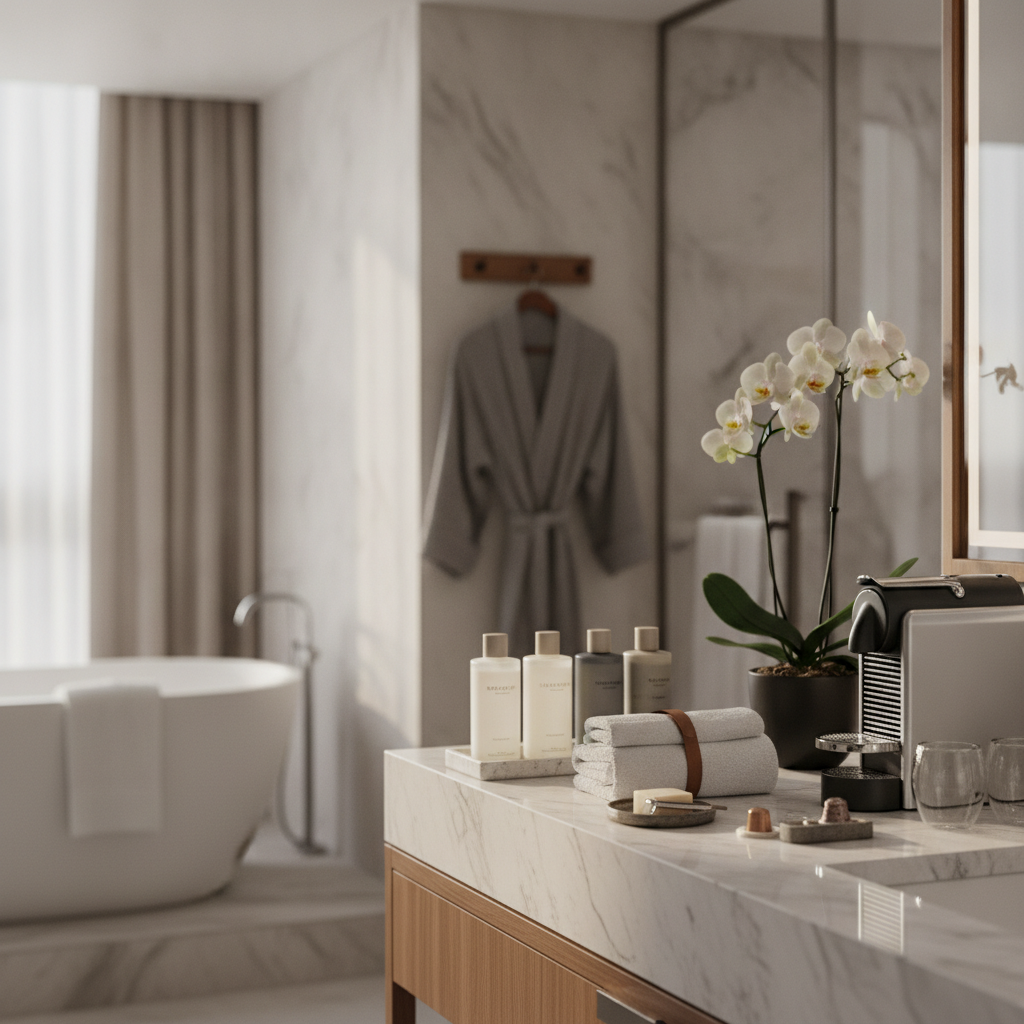
Guests no longer judge a property by its thread count alone. Today, luxury hotel amenities are the single biggest lever general managers, spa directors, and owners have for lifting ADR, TRevPAR, and guest loyalty — and the properties winning in 2026 are the ones treating amenities as a revenue strategy, not a cost center.
TL;DR — The Bottom Line
Luxury hotel amenities — spas, recovery and wellness circuits, personalized technology, and design-led experiences — now directly drive revenue, not just satisfaction scores. Hotels with major wellness amenities generate more than twice the TRevPAR of properties with none, and wellness travelers spend roughly 61% more per trip than average guests. The winning approach for 2026 isn't the biggest amenity build — it's the leanest, highest-usage mix that matches your guest profile and property positioning.
Quick Facts
- TRevPAR lift from major wellness amenities: more than 2x hotels with no wellness offering
- Luxury vs. upper-upscale wellness TRevPAR gap: roughly 3x higher for luxury properties with major wellness
- Wellness tourism spend share: ~19% of all global tourism spending
- Wellness trip volume: over 1 billion wellness trips taken in 2023
- Hotel/resort spa revenue growth: ~9.4% annually from 2019–2024
- Extra spend by wellness travelers: ~61% more per trip than average tourists
What Counts as Luxury Hotel Amenities in 2026?
The definition of luxury hotel amenities has shifted dramatically over the past five years. A decade ago, "luxury" meant marble bathrooms, a rooftop pool, and a well-stocked minibar. Today, affluent travelers expect amenities that deliver a measurable outcome — better sleep, faster recovery, a more personalized stay, or a genuine sense of place. Analysts tracking the space note that hotels are layering meditation, sleep programming, and holistic wellness into their amenity mix alongside traditional spas and gyms, rather than treating wellness as a single standalone service.
For hotel leaders, this means the amenity conversation has expanded well beyond the spa menu. It now includes hydrotherapy and contrast circuits, sleep-focused room technology, curated fitness programming, mindfulness and recovery spaces, sustainability-forward design, and hyper-personalized guest services. The common thread across all of these is that guests want amenities that do something for them, not just amenities that look impressive in a brochure.
Recovery and wellness amenities (contrast therapy, sleep programming, spa treatments), personalized technology, curated fitness, and design-led public spaces are currently the highest-demand categories, with recovery and sleep-focused offerings growing fastest.
The Business Case: How Luxury Hotel Amenities Drive Revenue
The strongest argument for investing in luxury hotel amenities isn't guest satisfaction scores — it's the balance sheet. According to RLA Global's Wellness Real Estate benchmark research, hotels with major wellness amenities generate more than twice the Total Revenue per Available Room (TRevPAR) of hotels with no wellness income at all, and major wellness properties post TRevPAR that is 56% higher than "minor wellness" hotels and 108% higher than hotels with none.
The gap is even more pronounced at the top of the market. Luxury properties with major wellness amenities achieve TRevPAR roughly three times that of upper-upscale hotels offering wellness, confirming that wellness-driven luxury hotel amenities are disproportionately powerful for premium properties. Interestingly, upper-upscale hotels with leaner wellness offerings have recently outperformed luxury properties in ADR and TRevPAR growth rate — a signal that smart, focused amenity investments can outperform sprawling, complex builds in terms of incremental return.
On the demand side, the Global Wellness Institute reports that travelers took more than 1 billion wellness trips in 2023, and wellness tourism now represents close to 19% of all global tourism spending — nearly one in five travel dollars. Wellness travelers also spend approximately 61% more per trip than standard tourists, and hotel and resort spas are the fastest-growing segment of the wellness economy, posting roughly 9.4% annual revenue growth between 2019 and 2024.
"Hotels with major wellness amenities generate more than twice the TRevPAR of properties offering none — making luxury hotel amenities one of the most reliable revenue levers available to owners today."
The Core Categories of Luxury Hotel Amenities Guests Expect
Not all amenities are created equal, and property leaders often overinvest in low-usage features while underinvesting in the categories guests actually seek out. Below is how the major categories of luxury hotel amenities typically break down by guest demand and revenue potential.
| Amenity Category | Guest Priority | Revenue Potential | Typical Adoption Challenge |
|---|---|---|---|
| Spa & wellness treatments | Very high | High (direct spend) | Staffing, space, treatment room capacity |
| Recovery & hot-cold circuits | Rising fast | High (repeat use, upsell) | Plumbing, footprint, maintenance |
| Sleep & recovery tech | High | Medium-High | Upfront tech investment |
| Fitness & curated movement | High | Medium | Space allocation, instructor cost |
| Personalized concierge tech | Medium-High | Medium (loyalty driver) | Integration with PMS/CRM |
| Design-led public spaces | Medium | Indirect (brand/ADR) | Capital cost, ongoing upkeep |
| Sustainability features | Growing | Indirect (brand loyalty) | Cost-benefit clarity |
The pattern in the data is clear: recovery-oriented and wellness-driven luxury hotel amenities now compete directly with traditional spa treatments for guest attention and spend, and they tend to have lower ongoing labor costs than treatment-heavy spa models.
Wellness and Recovery: The Fastest-Growing Amenity Segment
Sleep and recovery have become headline categories within luxury hotel amenities rather than afterthoughts. Hilton's own travel trend research found that more than a quarter of travelers now book spa or wellness treatments specifically to improve their sleep, and hotel wellness programming increasingly includes guided breathing, recovery modalities, and sleep rituals rather than generic relaxation massages.
Virtuoso's advisor network similarly reports that hotels are moving toward more comprehensive wellness experiences — meditation, structured sleep programs, and curated fitness — instead of standard gym classes and a single spa menu. This shift toward outcome-based wellness is why hydrotherapy, contrast therapy, and recovery-focused luxury hotel amenities are commanding so much attention from spa directors and property owners heading into 2026.
They increase both. Wellness travelers spend roughly 61% more per trip than average tourists, and hotel/resort spas are growing revenue at approximately 9.4% annually, showing that well-chosen amenities directly convert into incremental guest spend, not just higher review ratings.
Personalization and Technology as Luxury Hotel Amenities
Personalization has quietly become one of the most valuable categories of luxury hotel amenities, even though it rarely appears on a printed amenity list. Affluent travelers increasingly expect their preferences — room temperature, pillow firmness, dietary restrictions, preferred wellness routines — to be anticipated before they arrive. This is where technology-enabled personalization intersects with wellness: smart room controls, app-based spa booking, biometric recovery tracking, and pre-arrival wellness questionnaires all fall under the modern definition of luxury hotel amenities.
Properties that integrate this kind of personalization tend to see stronger loyalty program engagement and higher ancillary spend, because the guest experience feels tailored rather than generic. For GMs evaluating capital projects, technology-driven personalization is often one of the lower-cost, higher-margin luxury hotel amenities available, since it leverages existing PMS and CRM infrastructure rather than requiring new physical space.
Sustainable and Design-Led Luxury Hotel Amenities
Design and sustainability now sit alongside wellness as core pillars of the luxury hotel amenities conversation. Guests increasingly evaluate a property's public spaces, materials, and environmental practices as part of their overall perception of luxury — not as a separate ethical consideration. Locally sourced materials, energy-efficient wellness equipment, and thoughtfully designed recovery or spa spaces all reinforce a property's premium positioning while supporting long-term operating cost reduction.
This is particularly relevant for owners weighing capital projects: design-led luxury hotel amenities that also reduce utility and maintenance costs (efficient HVAC in spa areas, water-conscious hydrotherapy systems, durable natural materials) deliver a dual return — brand differentiation now, and cost savings over the amenity's operating life.
How to Choose the Right Luxury Hotel Amenities for Your Property
Given the breadth of options, GMs and owners need a structured way to decide which luxury hotel amenities are worth the capital and operating investment. The following steps reflect how top-performing properties approach amenity planning.
- Audit your current guest profile and length of stay. Business travelers, leisure families, and wellness-motivated guests all respond to different luxury hotel amenities — align investment with who actually books your property.
- Benchmark against your competitive tier, not aspirational brands. Compare your amenity mix to properties in your actual market segment rather than flagship luxury resorts with vastly larger budgets.
- Prioritize high-usage, low-complexity amenities first. Data shows leaner wellness models often grow revenue faster than large, underutilized complexes — start with amenities guests will use daily, not occasionally.
- Model revenue impact before committing capital. Estimate incremental ADR, treatment/upsell revenue, and guest retention impact using industry benchmarks like TRevPAR growth from comparable wellness investments.
- Pilot before scaling. Test new luxury hotel amenities in a limited number of rooms or a single wellness space before committing to a property-wide rollout.
- Train staff to actively promote amenities. Even the best luxury hotel amenities underperform if front desk and concierge teams don't actively surface them during booking and check-in.
Property teams looking for guidance on integrating wellness-focused equipment into their amenity strategy can review the resources available at HotelPlunge, which specializes in hotel wellness equipment designed for measurable guest impact and operational simplicity.
Common Mistakes Hotels Make With Luxury Hotel Amenities
Even well-capitalized properties make predictable errors when planning luxury hotel amenities. The most common include:
- Overbuilding for aspiration rather than usage. A sprawling spa with low utilization drags down TRevPAR compared to a smaller, consistently booked wellness offering.
- Treating amenities as marketing props instead of revenue centers. Amenities photographed for the website but poorly integrated into booking flows and upsell paths leave revenue on the table.
- Ignoring staff training and promotion. Guests often don't know an amenity exists unless it's actively surfaced during booking, check-in, or in-room materials.
- Underestimating maintenance and operating costs. Some luxury hotel amenities look impressive on paper but carry ongoing costs that erode their net revenue contribution.
- Copying competitor amenities without matching guest demand. The right luxury hotel amenities are the ones your specific guest base will actually use, not the ones a competing property down the street has installed.
Most properties track TRevPAR, ADR growth, ancillary spend per occupied room, and guest retention/loyalty metrics before and after an amenity launch, comparing performance against industry benchmarks for wellness-focused hotels.
Frequently Asked Questions
What are luxury hotel amenities?
Luxury hotel amenities are the curated spaces, services, technology, and experiences a hotel offers to differentiate its stay — including spas, recovery and wellness facilities, personalized technology, curated fitness, and design-led public spaces — that justify premium pricing and increase guest spend.
Do luxury hotel amenities really increase hotel revenue?
Yes. Hotels with major wellness amenities generate more than twice the TRevPAR of hotels with no wellness offering, and wellness travelers spend roughly 61% more per trip than average tourists, making well-chosen amenities a measurable revenue driver rather than just a satisfaction booster.
What luxury hotel amenities are trending in 2026?
Recovery and hot-cold contrast circuits, sleep-focused wellness programming, personalized technology, curated fitness experiences, and design-led sustainable spaces are the fastest-growing categories heading into 2026.
Should smaller or upper-upscale hotels invest in luxury hotel amenities?
Yes. Upper-upscale hotels with leaner, well-targeted wellness amenities have recently outperformed luxury properties in ADR and TRevPAR growth, showing that focused, high-usage amenities can deliver strong returns even without a massive spa build.
How do hotels decide which luxury hotel amenities to invest in?
Property leaders should audit their guest profile, benchmark against their competitive tier, prioritize high-usage low-complexity amenities, model expected revenue impact, and pilot new amenities before scaling property-wide.
Bringing It All Together
The data is unambiguous: luxury hotel amenities have moved from a soft differentiator to a core revenue strategy. Properties that treat wellness, recovery, personalization, and design as integrated parts of the guest experience — rather than disconnected line items — are the ones capturing outsized TRevPAR growth, higher guest spend, and stronger loyalty. The winning formula for 2026 isn't necessarily the biggest amenity build; it's the smartest one, matched precisely to your guests and executed with operational discipline.
For hotel leaders ready to evaluate wellness-focused equipment as part of their amenity strategy, HotelPlunge offers guidance on selecting solutions built for real guest usage and measurable property performance. Reach out to start planning your property's next generation of luxury hotel amenities.