Cold plunge benefits for hotel staff wellness programs
September 7, 2026 · 13 min read
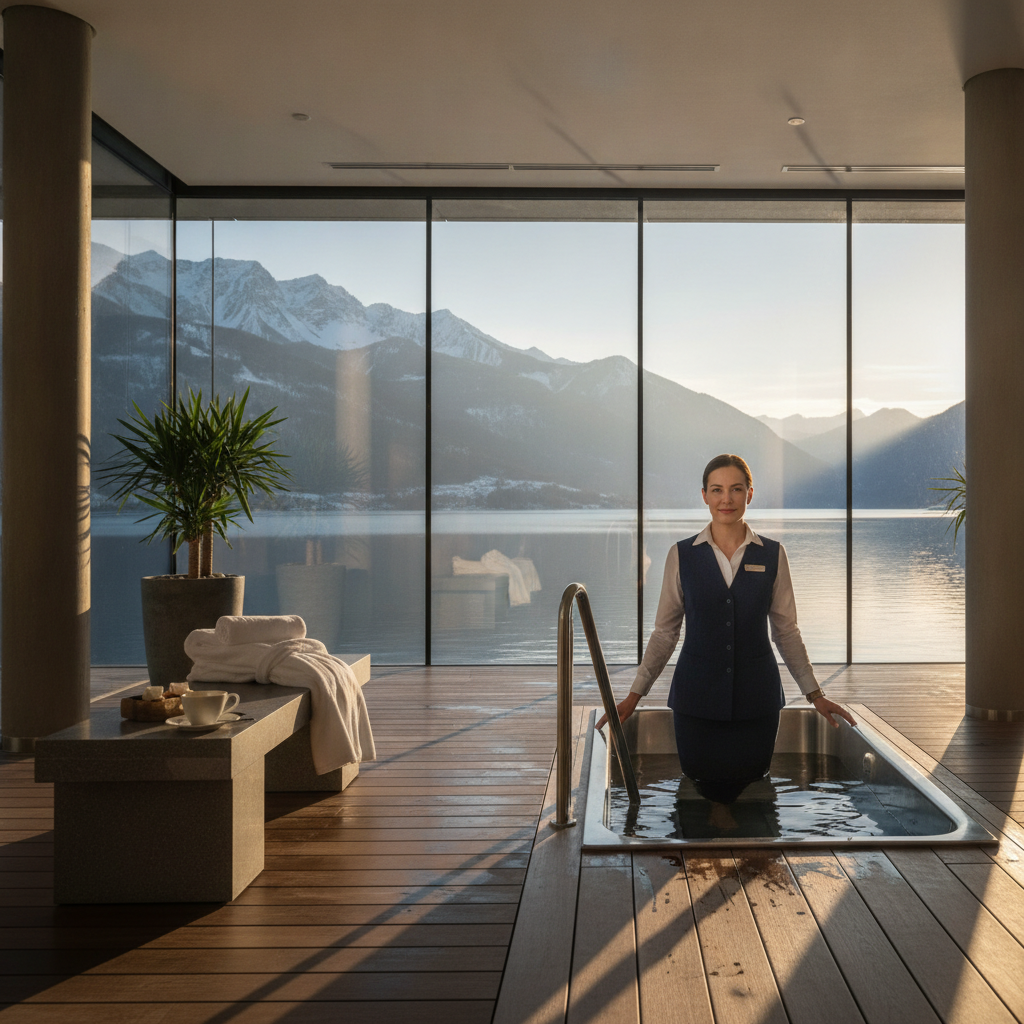
Cold plunge benefits for hotel staff wellness programs are moving from a spa-menu footnote to a measurable lever for reducing turnover, workers' compensation costs, and burnout across housekeeping, kitchen, and front-of-house teams. While most hospitality coverage of cold-water immersion focuses on guests soaking in a spa suite, the real untapped opportunity for General Managers, Spa & Wellness Directors, and Property Owners sits backstage — with the employees who lift, bend, stand, and stress their way through every shift.
This guide breaks down the physiological and psychological evidence behind cold plunge benefits for hotel staff wellness programs, and shows how a property can structure an employee-focused program that protects people, not just guest satisfaction scores.
TL;DR — The Bottom Line
Cold plunge benefits for hotel staff wellness programs include measurable reductions in musculoskeletal pain, faster recovery for housekeeping and kitchen teams, and documented drops in stress within 12 hours of immersion. With musculoskeletal disorders (MSDs) affecting up to 90% of kitchen staff and over half of housekeepers, a structured cold-water immersion program — even one shared unit in a back-of-house break area — can become one of the lowest-cost, highest-visibility investments in an occupational wellness strategy.
Quick Facts
- Low back pain in housekeepers: approximately 54% report symptoms in recent occupational reviews
- Kitchen staff MSD prevalence: up to 82.7%–90%+ report musculoskeletal disorders within a 12-month period
- Workers' comp share from MSDs: roughly 48% of hospitality claims are tied to musculoskeletal injury
- Stress reduction window: measurable stress reduction reported up to 12 hours after cold-water immersion
- Lost workdays: 7.8 million lost working days linked to MSDs in one national economy during 2023/24
- Post-pandemic sick leave shift: nearly 50% of hospitality sector absences now linked to MSDs, with psychological disorder claims up roughly 50% versus 2019
What Are Cold Plunge Benefits for Hotel Staff Wellness Programs?
At its core, the cold plunge benefits for hotel staff wellness programs concept applies the same cold-water immersion science used in professional sports recovery to the physically demanding jobs inside a hotel. Housekeepers push carts and bend repeatedly for eight-hour shifts. Kitchen stewards lift, twist, and stand on hard tile for ten-plus hours. Bell staff and door teams carry luggage in extreme weather. Front desk and spa employees hold static postures that strain the neck and shoulders. Each role produces a distinct injury and stress profile, and cold-water immersion addresses several of them at once.
Unlike guest-facing cold plunge installations — which tend to be discussed in terms of design, luxury positioning, or in-room plumbing — a staff wellness application is built around access, scheduling, and occupational health outcomes. That distinction matters enormously to how a property justifies the investment, where the unit is placed, and how success gets measured internally.
A: The underlying physiology — vasoconstriction, reduced inflammatory markers, and a documented drop in perceived stress — works the same way regardless of who steps in. The difference is programmatic: staff wellness applications prioritize back-of-house placement, shift-based scheduling, and safety protocols over spa ambiance.
The Hidden Occupational Health Crisis Driving Demand for Cold Plunge Benefits
The business case for cold plunge benefits for hotel staff wellness programs starts with a sobering data set. A 2024 systematic review of hotel workers found low back pain in roughly 54% of housekeepers and cleaners, shoulder pain in about 41%, and wrist or hand pain in nearly 40% — figures that mirror the repetitive strain patterns seen across the broader hospitality workforce, according to occupational health research indexed by the U.S. National Library of Medicine (PubMed).
Kitchen operations show even steeper numbers. Studies report a one-year MSD prevalence of 82.7% among kitchen workers, with some hospitality cohorts reporting that more than 90% of kitchen staff experience musculoskeletal complaints in the low back, knees, feet, neck, or shoulders over a 12-month period. Sector-wide claims data suggests musculoskeletal injuries account for roughly 48% of workers' compensation claims in hospitality, driven by heavy lifting, repetitive motion, and slip-and-fall incidents — a pattern consistent with guidance published by the Occupational Safety and Health Administration (OSHA).
Post-pandemic labor data compounds the picture: work-related MSDs contributed to 7.8 million lost working days in one recent reporting year, affecting roughly 168,000 workers, and hospitality-specific sickness absence data shows nearly half of all absences now linked to MSDs, alongside a roughly 50% increase in psychological disorder claims compared with 2019. For GMs and owners already managing thin labor margins, this is not an abstract wellness talking point — it is a direct line item.
Physical Recovery: The Core Cold Plunge Benefits for Hotel Staff Wellness Programs
Most controlled evidence on cold-water immersion (CWI) comes from sports recovery and occupational medicine research, but the physiological mechanisms translate directly to hospitality work. Cold exposure triggers vasoconstriction followed by rebound vasodilation, which is associated with reduced localized inflammation and lower perceived muscle soreness after physically demanding shifts. For staff who push carts, lift trays, or stand on hard floors for ten hours, this can meaningfully shorten next-day recovery time.
Applied specifically to hospitality roles, the physical cold plunge benefits for hotel staff wellness programs cluster around three groups:
- Housekeepers and room attendants — targeted relief for back, shoulder, and wrist strain from repetitive bending, lifting, and cart-pushing.
- Kitchen staff and stewards — recovery support for knee, foot, and low-back stress from prolonged standing and heavy lifting on hard surfaces.
- Spa therapists and front-desk staff — relief for neck and shoulder strain associated with static posture and repetitive upper-body movement.
Direct randomized controlled trials on hotel employees specifically remain limited, but the extrapolation from occupational MSD prevalence data and established recovery science supports positioning cold-water immersion as an adjunct recovery tool within a broader ergonomics and occupational health program — not a replacement for proper lifting training, ergonomic equipment, or scheduled breaks.
Mental Health, Burnout, and the Psychological Cold Plunge Benefits for Hotel Staff Wellness Programs
Physical recovery is only half of the equation. A 2024 systematic review covering more than 3,000 participants found that cold-water immersion was associated with reduced stress measured up to 12 hours post-immersion, along with improvements in sleep quality and overall quality of life. For an industry where front-line burnout scores are consistently among the highest across tourism and hospitality sector reports, this is a meaningful data point.
Hospitality is a high-emotional-labor industry: guest complaints, understaffing, irregular hours, and physically taxing shifts compound to create chronic low-grade stress. Cold plunge exposure appears to interrupt that stress cycle by activating the parasympathetic nervous system after the initial cold shock response, which practitioners describe as a reset that supports mental clarity and mood regulation for the remainder of a shift or before commuting home.
A: Research on cold-water immersion shows measurable reductions in perceived stress within hours of a session, with some studies tracking benefits up to 12 hours post-immersion. For hotel staff, this makes a short, supervised session immediately before or after a shift a practical window for stress relief.
Framed correctly, cold plunge benefits for hotel staff wellness programs extend beyond physical therapy into a documented mental health intervention — one that costs a fraction of an employee assistance program expansion or a rotating wellness stipend, while delivering a tangible, on-property experience staff can access without leaving work.
Building a Staff-First Cold Plunge Program: A Practical Framework
Most commercial cold plunge vendors design for guest circuits — spa suites, pool decks, fitness centers. Building a program specifically around cold plunge benefits for hotel staff wellness programs requires a different set of decisions. Here is a practical sequence for GMs and Spa & Wellness Directors evaluating the idea:
- Identify high-risk departments first. Use existing workers' comp claims data and absence records to confirm which departments — typically housekeeping, kitchen, and stewarding — carry the highest MSD burden at your property.
- Choose a back-of-house location. Break rooms, locker areas, or staff wellness corners near loading docks work better than guest-adjacent spaces, both for privacy and for scheduling flexibility.
- Set clear access windows. Build cold plunge access into shift-change routines — end-of-shift for physical recovery, pre-shift for stress management — rather than leaving access unstructured.
- Establish safety protocols. Time limits, supervision during initial onboarding, and clear medical exclusion criteria (cardiovascular conditions, pregnancy, open wounds) protect both staff and the property.
- Pair with education, not just equipment. A five-minute onboarding on breathing technique and safe immersion time dramatically increases adherence and reduces first-time anxiety.
- Track outcomes quarterly. Monitor absenteeism, workers' comp claims, and voluntary participation rates to build an internal case for expansion.
Properties exploring dedicated equipment for this purpose can review commercial-grade options built for continuous, multi-user hospitality environments at HotelPlunge, where systems are designed with durability and daily-use cycles in mind rather than single-guest luxury staging.
Cold Plunge Benefits for Hotel Staff Wellness Programs vs. Guest-Facing Amenities
It's worth being explicit about how a staff-focused program differs from the guest amenity most hotels already discuss internally. The two use cases share equipment but diverge sharply in objectives, placement, and measurement.
| Factor | Guest-Facing Cold Plunge | Staff Wellness Cold Plunge Program |
|---|---|---|
| Primary goal | Differentiated guest experience, ancillary revenue | Reduced MSD burden, lower absenteeism, retention |
| Location | Spa suite, pool deck, in-room | Back-of-house break area, staff locker room |
| Usage pattern | Occasional, leisure-paced | Scheduled, shift-aligned, higher daily frequency |
| Success metric | Guest satisfaction scores, upsell revenue | Workers' comp claims, sick days, turnover rate |
| Design priority | Aesthetics, privacy, luxury finish | Durability, hygiene turnover, ease of supervision |
Recognizing this distinction is what allows cold plunge benefits for hotel staff wellness programs to be pitched to ownership as a distinct occupational health investment — separate from, and often cheaper to justify than, a guest-facing spa upgrade.
Measuring ROI: KPIs to Track Cold Plunge Benefits for Hotel Staff Wellness Programs
Every wellness initiative competes for capital against revenue-generating projects, so a credible measurement plan matters. Properties piloting cold plunge benefits for hotel staff wellness programs should track:
- Workers' compensation claim frequency in high-risk departments, quarter over quarter
- Unplanned absence rates, particularly MSD-coded sick days
- Voluntary participation rate among eligible staff (a strong proxy for perceived value)
- Retention and time-to-fill for housekeeping and kitchen roles, which are consistently the hardest positions to staff
- Employee survey sentiment on physical fatigue and stress before and after program rollout
Given that MSDs already account for roughly 48% of hospitality workers' comp claims, even a modest reduction in claim frequency can offset the cost of a commercial cold plunge unit within one to two budget cycles. Property owners evaluating capital requests should ask spa and HR leadership to co-present these numbers jointly, since the outcome sits at the intersection of both departments.
Frequently Asked Questions
What are the main cold plunge benefits for hotel staff wellness programs?
The primary benefits include reduced musculoskeletal pain and inflammation for physically demanding roles like housekeeping and kitchen work, measurable stress reduction within hours of immersion, improved sleep quality, and a lower-cost occupational wellness offering that can reduce absenteeism and workers' compensation claims over time.
Which hotel departments benefit most from a cold plunge wellness program?
Housekeeping, kitchen and stewarding, and spa therapy teams show the highest documented rates of musculoskeletal complaints — low back, shoulder, wrist, knee, and foot pain — making them the priority groups for a staff-focused cold plunge program.
Is cold plunge safe for all hotel employees to use?
Cold-water immersion is not appropriate for everyone. Employees with cardiovascular conditions, uncontrolled hypertension, pregnancy, open wounds, or certain circulatory disorders should be excluded or cleared by a physician first. A basic screening form and clear time limits are standard practice for any staff wellness cold plunge program.
How is a staff wellness cold plunge program different from a guest spa amenity?
A staff program prioritizes back-of-house placement, shift-aligned scheduling, durability for high daily use, and occupational health metrics like absenteeism and workers' comp claims. A guest amenity prioritizes design, privacy, and guest satisfaction or upsell revenue instead.
How quickly can a hotel expect to see results from a staff cold plunge program?
Stress-related benefits can appear within hours of a session, but measurable shifts in absenteeism, workers' comp claims, or turnover typically require one to two full budget quarters of consistent access and participation tracking to demonstrate a reliable trend.
Conclusion: Making Cold Plunge Benefits for Hotel Staff Wellness Programs a Priority
The data is consistent across occupational health research: hotel staff, particularly in housekeeping, kitchen, and stewarding roles, carry a disproportionate burden of musculoskeletal disorders and stress-related conditions. Cold plunge benefits for hotel staff wellness programs offer a low-footprint, evidence-aligned way to address both — provided the program is built around employee access, safety, and measurement rather than treated as a guest-amenity afterthought.
For General Managers, Spa & Wellness Directors, and Property Owners ready to evaluate a staff-focused pilot, the next step is matching equipment durability and daily-use design to the realities of a working hotel — not a spa brochure. Explore commercial-grade systems built for that purpose at HotelPlunge, and start the conversation with HR and operations leadership about where cold plunge benefits for hotel staff wellness programs could make the biggest difference on your property.