Modular Cold Plunge System for Hotels: How It Works
August 16, 2026 · 13 min read
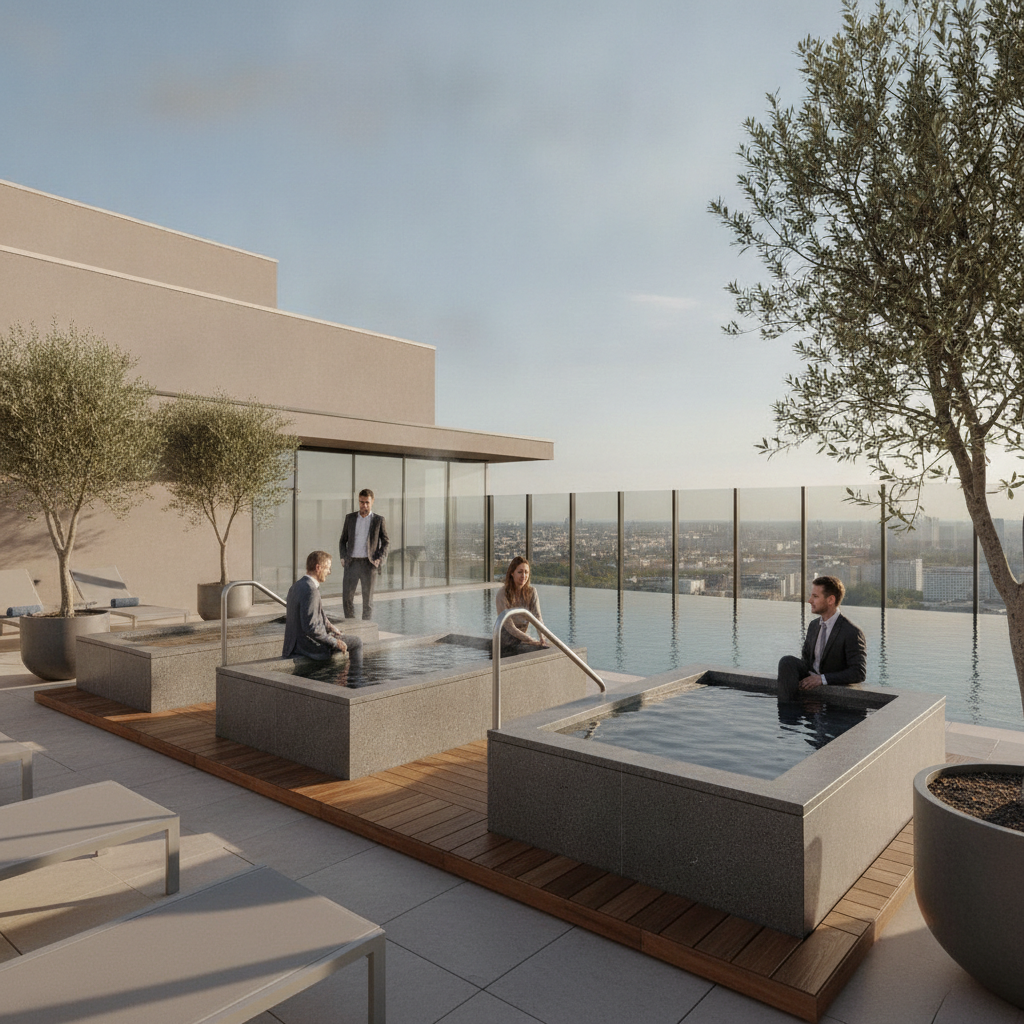
A modular cold plunge system for hotels is quickly becoming the default infrastructure choice for properties building out serious wellness programming — not because it's trendy, but because it solves real operational problems that built-in pools and consumer-grade tubs cannot. For General Managers, Spa & Wellness Directors, and Property Owners evaluating cold therapy investments, understanding the underlying architecture of these systems is the difference between a durable revenue asset and a maintenance headache. This guide breaks down exactly how a modular cold plunge system for hotels is engineered, why the model is winning market share, and what to evaluate before you commit capital.
TL;DR — The Bottom Line
A modular cold plunge system for hotels separates the guest-facing tub from the mechanical chiller, pump, and filtration unit (the "brain"), which can sit up to roughly 60 feet away in a plant room. This architecture allows hotels to serve multiple tubs from one mechanical unit, reduce noise in guest-facing spaces, simplify maintenance access, and retrofit wellness amenities into constrained footprints. With hydrotherapy now offered by 81% of resort spas and cold plunge installations up an estimated 15% in luxury hotels since 2021, modular design has become the practical standard for scaling cold therapy across a property or portfolio.
Quick Facts
- Remote plant placement: Modular "brain" units can be located up to ~60 feet from the tub via insulated plumbing
- Resort spa adoption: 81% of resort spas now offer hydrotherapy/cold plunge amenities, up from ~65% in 2019
- Luxury hotel growth: Cold plunge installations in luxury hotels rose roughly 15% between 2021 and 2023
- 4-5 star adoption: Cold plunge pools as standard amenities grew ~40% among 4- and 5-star North American properties, 2021–2024
- Revenue link: Wellness amenity packages including cold plunge correlate with 8–15% higher average daily rate
- Market size: The global cold plunge product market is projected to reach roughly $300 million by 2028
What Is a Modular Cold Plunge System for Hotels?
In a hospitality context, a modular cold plunge system for hotels refers to a design approach where the guest-facing tub is physically and mechanically separated from the equipment that cools, circulates, and sanitizes the water. This is different from a built-in cold plunge pool, where the chiller and filtration are hardwired into a single fixed installation beneath or beside the tub itself.
The term "modular" doesn't just describe a product category — it describes an installation philosophy. Instead of treating cold plunge as a single fixed fixture, hotels treat it as infrastructure that can be sized, relocated, and expanded as wellness programming grows. This matters enormously for General Managers and Property Owners because it reframes cold plunge from a one-off spa purchase into a scalable capital asset.
Answer: No. Portable units are self-contained, plug-and-play tubs with the chiller built into the tub itself. A modular cold plunge system for hotels separates the tub from the chiller entirely, which allows for quieter guest spaces, remote plant rooms, and shared mechanical capacity across multiple tubs — something portable units cannot do.
How Modular Cold Plunge Systems Work: Separating the Tub from the "Brain"
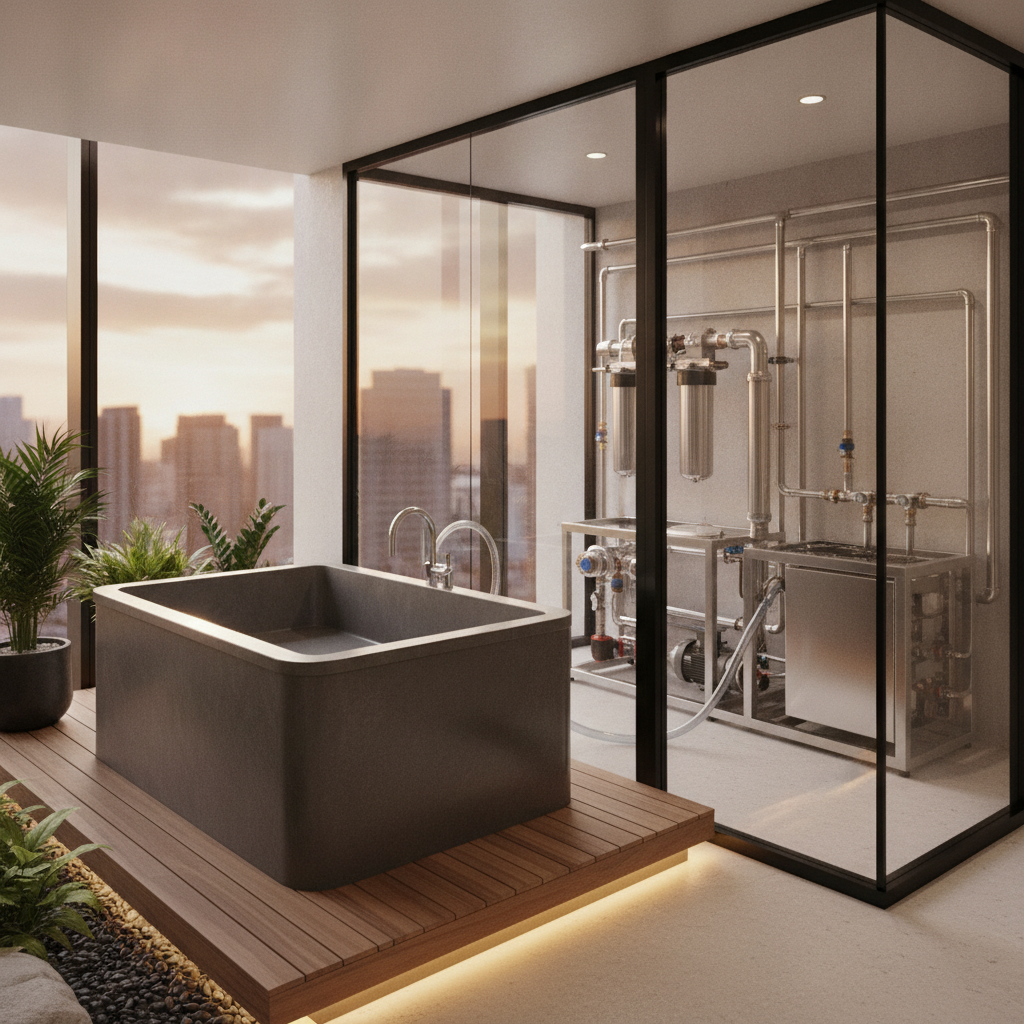
The core engineering principle behind a modular cold plunge system for hotels is straightforward: keep the guest experience quiet, clean, and aesthetically controlled, while housing the noisy, heat-generating mechanical components somewhere out of sight.
- The tub — installed in the spa treatment room, wellness circuit, pool deck, or guest bathroom. It's typically finished in stone, tile, acrylic, or composite material chosen to match the design language of the property.
- The plant unit — the chiller, circulation pump, filtration media, and digital controls, housed in a mechanical closet, back-of-house utility room, or dedicated plant space. Vendors in this category, including systems similar to BlueCube's Modular Series, allow the plant to sit up to approximately 60 feet from the tub using insulated supply and return lines.
- The connective plumbing — insulated lines that carry chilled, filtered water between the plant and the tub, engineered to minimize thermal loss over distance.
- Controls and monitoring — many commercial-grade systems include remote diagnostics, allowing engineering teams to monitor water temperature, filtration cycles, and system health without physically inspecting each tub.
This separation is what allows a modular cold plunge system for hotels to support hospitality-specific requirements that a residential or built-in setup simply cannot: acoustic control in guest-facing rooms, centralized maintenance access for engineering staff, and design flexibility for architects working within tight spa footprints.
Modular vs. Built-In Cold Plunge Infrastructure: A Side-by-Side Comparison
Property Owners and Spa Directors comparing options often default to built-in pools because that's the traditional aquatics model. But a modular cold plunge system for hotels typically outperforms built-in infrastructure on the metrics that matter most in a commercial hospitality setting.
| Factor | Modular Cold Plunge System | Built-In Cold Plunge Pool |
|---|---|---|
| Guest-area noise | Low — chiller housed remotely | Higher — mechanicals often adjacent to tub |
| Multi-tub scalability | One plant can serve multiple tubs | Each pool typically needs its own equipment |
| Maintenance access | Centralized, engineering-friendly | Often requires deck or floor access |
| Retrofit suitability | High — fits constrained spa footprints | Low — usually requires structural work |
| Design flexibility | Tub finish independent of mechanicals | Fixed to original construction |
| Typical deployment timeline | Weeks | Months |
Answer: Yes. Many modular chiller units are rated to power multiple tubs simultaneously — commonly one to three — which is why larger spas and wellness circuits favor modular architecture over single-tub built-in installations.
Why Hotels Are Adopting Modular Cold Plunge Systems: The Market Data
The shift toward modular cold plunge system for hotels adoption isn't anecdotal — it's backed by consistent growth data across both the wellness industry and hospitality sector specifically.
- The global cold plunge and cold water therapy product market was valued at approximately $166 million in 2023 and is projected to reach roughly $300 million by 2028, a 12–14% compound annual growth rate, according to industry market research (Global Wellness Institute).
- Hydrotherapy amenities, including cold plunge, were offered by approximately 72% of day spas and 81% of resort spas in North America in 2023 — up from roughly 55% and 65% respectively in 2019, per ISPA benchmarking data (International SPA Association).
- Hotel properties adding cold plunge pools as a standard wellness amenity grew approximately 40% among 4-star and 5-star properties in North America between 2021 and 2024, according to hospitality benchmarking research.
- Wellness amenity packages that include cold plunge access are associated with 8–15% higher average daily rate for the properties that offer them (Hospitality Net).
- Industry commentary reports that installations of cold plunge tubs in luxury hotels increased by around 15% from 2021 to 2023, reflecting the broader pivot toward recovery-focused hospitality.
"The properties seeing the strongest returns aren't the ones that bought a single novelty tub — they're the ones that built cold therapy as scalable infrastructure from the start," is a sentiment echoed across recent hospitality wellness benchmarking commentary, and it's exactly the gap a modular cold plunge system for hotels is designed to close.
Scaling Across a Portfolio: Multi-Tub and Multi-Property Deployment
For ownership groups and management companies operating multiple properties, the real advantage of a modular cold plunge system for hotels shows up at the portfolio level, not just the single-property level. Because the tub and plant are decoupled, brand standards teams can specify a consistent mechanical platform across properties while allowing each hotel's design team to customize tub finish, placement, and guest-facing presentation to match local branding.
This modularity supports a phased rollout strategy:
- Pilot property first. Install a single modular cold plunge system for hotels at a flagship or high-wellness-demand property to validate guest uptake and revenue impact before wider rollout.
- Standardize the mechanical spec. Lock in a consistent plant unit, filtration standard, and monitoring platform across the portfolio so engineering teams only need to train on one system.
- Right-size tub count per property. Use occupancy data and spa treatment volume to determine whether a property needs one tub or a multi-tub configuration fed by a shared plant.
- Centralize maintenance contracts. Negotiate a single service agreement across properties rather than per-site contracts, reducing per-unit maintenance cost.
- Track utilization and ADR impact. Compare wellness package uptake and rate performance across pilot and rollout properties to refine the business case for further expansion.
This is where the modular cold plunge system for hotels model diverges most sharply from a built-in pool strategy — built-in infrastructure locks each property into a bespoke, site-specific installation, while modular architecture allows a repeatable, portfolio-wide specification.
Procurement Checklist: Evaluating a Modular Cold Plunge System for Hotels
When Spa Directors and Property Owners evaluate vendors, the tub itself is often the least differentiated component. The mechanical plant, service model, and installation flexibility matter far more for long-term operating cost. Key questions to ask any vendor:
- Maximum plant-to-tub distance: Can the chiller be placed in an existing back-of-house space, or does it require a new dedicated room adjacent to the tub?
- Multi-tub capacity: How many tubs can one plant unit realistically support at commercial-grade duty cycles?
- Duty cycle rating: Is the chiller rated for continuous high-frequency commercial use, or built for residential intermittent use?
- Filtration and hygiene standard: What filtration media and sanitation cycle does the system use, and does it meet local health code requirements for shared-use water?
- Noise output: What is the decibel rating of the plant unit at operating load, and is remote placement sufficient to keep guest areas quiet?
- Remote diagnostics: Can engineering staff monitor temperature and system health without physical inspection of every tub?
- Service and parts availability: What is the typical response time for service calls, and are replacement parts stocked regionally?
Answer: Because the plant unit doesn't require the structural work associated with built-in pools, most modular installations can be completed in a matter of weeks rather than months, particularly when the plant room already has adequate electrical and drainage infrastructure.
Maintenance, Noise & Hygiene: Operational Considerations
Operationally, the biggest advantage hotel engineering teams report with a modular cold plunge system for hotels is separation of guest experience from maintenance activity. Because the chiller, pump, and filtration sit in a plant room, routine servicing — filter changes, water testing, chiller inspection — can happen without disturbing guests in the spa or wellness circuit.
Noise is a particularly important factor for luxury properties. Compressor-driven chillers generate mechanical noise and vibration; placing that equipment 20, 40, or up to roughly 60 feet away from a treatment room dramatically improves the acoustic quality of guest-facing spaces — something built-in systems, where the chiller often sits directly beneath or beside the tub, cannot replicate.
Hygiene is the other operational pillar. Commercial-grade modular systems typically include multi-stage filtration and UV or ozone sanitation cycles designed for high-turnover, multi-guest use — a materially different standard than a single-user residential tub. For shared spa environments, this filtration capacity is often what distinguishes a compliant commercial installation from a converted consumer product.
Frequently Asked Questions
What makes a cold plunge system "modular" rather than standard?
A modular cold plunge system for hotels separates the guest-facing tub from the mechanical chiller, pump, and filtration unit, allowing the equipment to be installed remotely — often up to about 60 feet away — rather than built directly into the tub structure.
How many tubs can one modular cold plunge system support?
Many commercial modular plant units are engineered to serve multiple tubs — commonly one to three — from a single chiller and filtration system, which improves the economics for larger spas and multi-treatment-room wellness circuits.
Is a modular cold plunge system for hotels more expensive than a built-in pool?
Upfront costs vary by configuration, but because one plant unit can serve multiple tubs and installation timelines are shorter, a modular cold plunge system for hotels often achieves lower per-tub cost and faster time-to-revenue than a comparable built-in installation, particularly for multi-tub spa layouts.
Can a modular cold plunge system be added during a hotel renovation without major construction?
Yes. Because the mechanical plant doesn't require the excavation or structural work associated with built-in pools, modular systems are generally well suited to renovation timelines, provided the plant room location has adequate electrical, drainage, and ventilation capacity.
How does a modular cold plunge system reduce noise in guest areas?
The compressor and pump — the primary sources of mechanical noise — are housed in a separate plant room rather than beside the tub, so guest-facing treatment rooms and wellness circuits stay significantly quieter than with built-in cold plunge pools.
Conclusion: Building Cold Plunge as Infrastructure, Not a Novelty
The data is consistent across every corner of the hospitality wellness market: guest demand for cold therapy is rising, resort spa adoption of hydrotherapy has climbed to 81%, and properties offering wellness amenity packages are commanding measurably higher rates. But the properties capturing the most value aren't the ones treating cold plunge as a single fixture purchase — they're the ones specifying a modular cold plunge system for hotels as scalable, repeatable infrastructure that can grow with guest demand and expand across a portfolio without re-engineering the approach at every property.
Whether you're piloting your first wellness circuit or standardizing a mechanical spec across a multi-property portfolio, the modular approach gives General Managers, Spa & Wellness Directors, and Property Owners the flexibility, scalability, and operational simplicity that built-in and consumer-grade alternatives simply can't match. To explore how a modular cold plunge system for hotels can be specified for your property, visit HotelPlunge and start planning your wellness infrastructure with a partner built specifically for hospitality-grade demands.