Cold Plunge Temperature for Hotels: Setting the Right Chill
October 6, 2026 · 13 min read
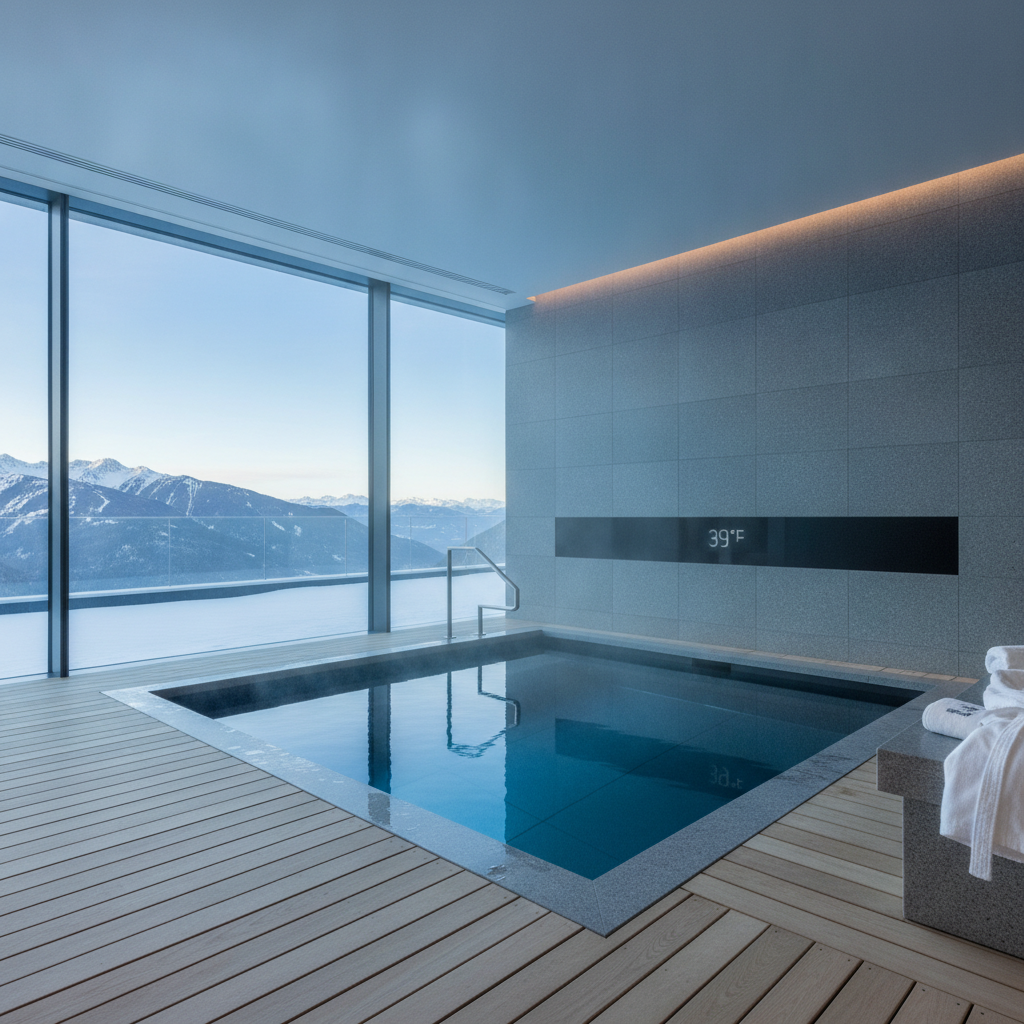
Setting the right cold plunge temperature for hotels is one of the most consequential decisions a wellness program makes — and one of the most commonly mishandled. Too warm, and guests feel shortchanged by a lukewarm tub that doesn't deliver the cold-therapy experience they expected. Too cold, and a property exposes itself to guest discomfort, liability, and real physiological risk. For hotel general managers, spa directors, and property owners evaluating in-suite or spa cold plunge programs, the question isn't just "how cold should it be?" — it's "how cold should it be for this specific guest, in this specific context, with this specific level of supervision?"
This guide breaks down the evidence-based temperature ranges that should guide every hotel cold plunge temperature decision, explains why duration and screening matter as much as the thermostat setting, and gives operators a practical framework they can hand directly to spa staff and engineering teams.
TL;DR — The Bottom Line
The evidence-supported cold plunge temperature for hotels generally falls between 10–15°C (50–59°F), with 11°C (52°F) frequently used in recovery-focused protocols. There is no single "optimal" number that applies to every guest — first-time or medically uncertain guests should start at a gentler 15–18°C (59–64°F) for 1–3 minutes, while experienced, screened guests may use 10–12°C (50–54°F). Hotels should avoid making sub-10°C (50°F) water the default setting, since risk rises faster than evidence of added benefit.
Quick Facts
- Evidence-supported range: 10–15°C (50–59°F) for most adult guests
- Common recovery benchmark: 11°C (52°F)
- Beginner-friendly entry point: 15–20°C (59–68°F) for 1–3 minutes
- Threshold operators should avoid defaulting below: 10°C (50°F)
- Typical session length: 2–5 minutes, protocol-dependent
- Conditions requiring clinician clearance: heart disease, arrhythmias, Raynaud's syndrome, uncontrolled hypertension, pregnancy
Why Cold Plunge Temperature for Hotels Matters More Than Equipment Choice
Hotels investing in cold plunge amenities often spend weeks comparing tub materials, chiller brands, and finishes — and only minutes deciding what temperature the water should actually be set to. That's backwards. The cold plunge temperature for hotels is the single variable that most directly determines guest experience, guest safety, and staff liability exposure. A beautifully designed tub set to the wrong temperature can either underwhelm guests or put them at genuine physiological risk.
Unlike a spa sauna, where temperature tolerance is forgiving and risk is gradual, cold water immersion triggers an immediate, involuntary physiological response: the cold shock response. Gasping, hyperventilation, and a spike in blood pressure happen within seconds of entry, regardless of a guest's fitness level. This is why hotels cannot treat cold plunge temperature as a design afterthought — it's an operational and safety decision first, an experiential one second.
What Is the Right Cold Plunge Temperature for Hotels? The Evidence-Based Range
There is no single, universally agreed-upon "optimal" cold plunge temperature. Harvard Health Publishing notes that research has not reached consensus on the best temperature, duration, or timing for cold-water immersion. That absence of consensus is actually useful information for operators: it means hotels should resist marketing claims that promise a single magic number, and instead build a tiered temperature framework.
That said, the research that does exist converges on a workable range. A review of cold-water-immersion studies identified 11–15°C (52–59°F) for 11–15 minutes as producing favorable outcomes in the protocols studied, while cautioning that very low temperatures can cause adverse effects, including nerve injury in extreme cases. Separately, cold-therapy researchers at Oxford Brookes University recommend 10–15°C (50–59°F) for most users, with 11°C (52°F) frequently used in recovery-focused settings — and explicitly warn that dropping below 10°C increases risk without clear evidence of additional benefit.
For hotels, this translates into a simple operating principle: the cold plunge temperature for hotels should rarely, if ever, default below 10°C (50°F). That threshold isn't arbitrary — it's where cold shock intensity rises sharply while the research-backed benefit curve flattens.
There isn't one. The strongest evidence supports a range of 10–15°C (50–59°F), with 11°C (52°F) commonly used in recovery protocols — but hotels should offer tiered settings based on guest experience level rather than fixing one number for every guest.
A Practical Temperature Framework for Hotel Guest Types
Because hotel guests arrive with wildly different tolerance levels, medical histories, and prior cold-plunge experience, a single fixed cold plunge temperature for hotels doesn't serve the full guest population well. Instead, spa and wellness teams should think in tiers, matching water temperature to guest context rather than treating every plunge as identical.
| Guest / Use Case | Suggested Water Temperature | Suggested Starting Duration | Operating Rationale |
|---|---|---|---|
| First-time guest or uncertain tolerance | 15–18°C (59–64°F) | 1–3 minutes | Reduces cold-shock intensity while staff assess tolerance |
| General hotel wellness use | 12–15°C (54–59°F) | 2–5 minutes | Balances a recognizable cold-plunge experience with broad accessibility |
| Experienced, screened guest | 10–12°C (50–54°F) | 2–5 minutes initially | Aligns with commonly studied recovery protocols; requires stronger controls |
| Athletic recovery / supervised protocol | 10–15°C (50–59°F) | Protocol-specific | Commonly studied range; longer exposure is not automatically better |
| Below 10°C (50°F) | Generally not recommended as default | Specialist supervision only | Higher cold stress without established incremental benefit for typical guests |
This framework is a starting point for operating decisions — not a medical prescription. No hotel should claim that a specific cold plunge temperature guarantees recovery, mood, metabolic, or cardiovascular benefits for guests, since the underlying research simply doesn't support that level of certainty.
Why Duration Matters as Much as Degrees
Operators often fixate on the thermostat number and overlook the second variable that determines guest experience and safety: time in the water. A cold plunge temperature for hotels set at 12°C (54°F) for two minutes produces a very different physiological load than the same temperature held for ten minutes. Research reviewing cold-water-immersion protocols commonly examined 11–15°C for 11–15 minutes in controlled, often athletic, settings — but that duration is not an appropriate default for a general hotel guest population stepping in without supervision history.
For most hotel use cases, 2–5 minutes is a reasonable starting duration, with first-time guests capped closer to 1–3 minutes regardless of temperature. Staff should be trained to treat duration as a lever they can adjust independently of temperature — a nervous first-time guest might handle 15°C for three minutes comfortably but struggle with 11°C for the same length of time.
Safety Protocols That Must Accompany Any Cold Plunge Temperature for Hotels
No cold plunge temperature setting is safe in isolation — temperature and supervision are a package. Cold-water immersion triggers rapid respiratory, cardiovascular, and sympathetic nervous-system responses regardless of how carefully a hotel calibrates its chiller. Harvard Health specifically advises against cold plunges for people with cardiovascular disease, heart-rhythm abnormalities, circulation disorders, peripheral artery disease, or Raynaud's syndrome. A 2026 review of cold-water-immersion safety reporting concluded that inconsistent data collection currently prevents experts from establishing that self-directed cold exposure is safe across all populations and settings — which means hotels cannot assume a guest's self-assessment is sufficient.
A commercially responsible hotel cold plunge program should include, at minimum:
- Pre-use screening: A simple intake form asking about heart disease, arrhythmias, uncontrolled hypertension, circulation disorders, Raynaud's syndrome, pregnancy, seizure history, acute illness, and medications affecting thermoregulation or judgment.
- Clear contraindication language: Guests with relevant conditions should be directed to obtain clinician clearance or avoid the plunge entirely — staff should never attempt to diagnose or clear guests medically.
- Controlled access: No unsupervised, unscreened first-time use, particularly at the colder end of the cold plunge temperature for hotels range.
- Visible temperature displays: Guests should always be able to see the current water temperature before entry.
- Emergency response protocol: Staff trained to recognize signs of cold shock, hyperventilation, or dizziness, with a clear escalation procedure.
Generally, no — not as a default setting. Cold-therapy researchers caution that temperatures below 10°C increase physiological risk without established additional benefit for typical users, so sub-10°C settings should be reserved for specialist-supervised protocols rather than standard hotel amenity use.
How to Calibrate and Monitor Cold Plunge Temperature for Hotels
Getting the number right on paper is only half the job — properties need a repeatable process to keep the cold plunge temperature for hotels accurate day to day, across housekeeping shifts, seasonal water supply changes, and equipment drift.
- Define your tiered temperature policy in writing. Document the exact ranges (e.g., 15–18°C for first-time guests, 10–12°C for screened, experienced guests) so every staff member references the same standard.
- Install a calibrated, redundant thermometer. Rely on the chiller's digital readout plus an independent waterproof thermometer check each shift — digital displays can drift over time without maintenance.
- Log temperature at set intervals. A simple shift-change log (morning, midday, evening) catches chiller malfunctions before a guest steps into water that's colder or warmer than intended.
- Train front-of-house and spa staff on the screening script. Every guest should be asked the same pre-use questions, regardless of how experienced they appear.
- Review incident and comfort feedback monthly. If guests consistently report the plunge feels "too intense" at a given setting, that's a signal to reassess the tier, not just individual guest tolerance.
- Service chillers on a fixed maintenance schedule. Temperature consistency depends on equipment reliability; a chiller that can't hold 12°C consistently is a bigger risk than choosing a slightly different number.
Common Mistakes Hotels Make With Cold Plunge Temperature
Several recurring errors show up across properties launching cold plunge amenities:
- Defaulting to the coldest possible setting for marketing impact. Below-10°C water generates buzz but adds risk the evidence doesn't support for general guest use.
- Treating every guest identically. A single fixed cold plunge temperature for hotels ignores the wide range of guest fitness levels, medical histories, and prior experience.
- Skipping written screening in favor of a verbal "are you okay with cold water?" question. Verbal-only screening is inconsistent and creates documentation gaps.
- Letting duration creep upward without protocol. Guests who enjoy the sensation often ask to stay longer; staff need clear maximum-duration guidance tied to each temperature tier.
- Neglecting ongoing calibration. A chiller that drifted from 12°C to 8°C over several months without anyone noticing is a liability event waiting to happen.
Choosing Equipment That Holds Temperature Consistently
Once a hotel has defined its cold plunge temperature for hotels policy, the equipment itself needs to reliably hold that number under real operating conditions — multiple guests per day, variable ambient temperatures, and limited engineering staff attention. This is where hospitality-grade cold plunge systems differ meaningfully from consumer-market tubs: commercial units need tighter thermostat tolerances, faster recovery time between uses, and filtration that keeps water sanitary at sustained low temperatures.
Properties evaluating options should prioritize systems with digital, lockable temperature controls (to prevent accidental guest adjustment), visible readouts, and documented chiller capacity matched to anticipated daily usage volume. HotelPlunge works with hotel operators to match equipment specifications to a property's intended cold plunge temperature for hotels policy, rather than selling a single fixed configuration regardless of use case. Learn more at HotelPlunge.
No. Temperature controls should be staff-locked. Guest-adjustable controls undermine the screening and tiering system a hotel has put in place and increase the chance of an inexperienced guest selecting an inappropriately cold setting.
Building a Cold Plunge Temperature Policy Guests Can Trust
Guests increasingly arrive at hotels having researched cold therapy on their own, often citing specific numbers from fitness influencers or home cold-plunge brands. Part of a hotel's job is managing that expectation gap responsibly. A well-communicated cold plunge temperature for hotels policy — posted near the plunge, included in spa menus, and explained during check-in for in-suite units — builds guest trust even when the hotel's chosen temperature is warmer than what a guest expected.
Framing matters here: rather than apologizing for not offering ice-bath-level cold, properties can position their tiered approach as more sophisticated and safety-conscious than a one-size-fits-all tub. "Our cold plunge is calibrated to evidence-based recovery ranges, not maximum shock value" is a stronger guest-facing message than simply advertising the lowest number on the dial.
Frequently Asked Questions
What is the ideal cold plunge temperature for hotels?
There is no single ideal number for every guest. The evidence-supported range is 10–15°C (50–59°F), with 11°C (52°F) commonly used in recovery protocols. Hotels should tier this range based on guest experience, starting first-timers at 15–18°C and reserving 10–12°C for screened, experienced guests.
Is colder always better for cold plunge benefits?
No. Research cautions that temperatures below 10°C (50°F) increase physiological risk, including rare but serious adverse effects, without clear evidence of added benefit over the 10–15°C range. Hotels should avoid treating extreme cold as a default or a marketing feature.
How long should hotel guests stay in a cold plunge?
Most hotel cold plunge protocols suggest 2–5 minutes, with first-time or medically uncertain guests limited to 1–3 minutes. Duration should be adjusted alongside temperature, not treated as a fixed number regardless of the water setting.
Which guests should avoid cold plunges entirely?
Harvard Health advises that individuals with cardiovascular disease, heart-rhythm abnormalities, circulation disorders, peripheral artery disease, or Raynaud's syndrome should avoid cold plunges or obtain clinician clearance first. Pregnant guests and those with acute illness should also be flagged during pre-use screening.
Do hotels need staff supervision for cold plunge amenities?
Yes. Unsupervised, unscreened access increases risk regardless of the chosen cold plunge temperature for hotels. Controlled access, visible temperature displays, documented screening, and staff trained in emergency response are standard requirements for a responsible hotel program.
Conclusion: Get the Number Right, Then Build the Program Around It
There is no shortcut around the fact that cold plunge temperature for hotels is a judgment call grounded in incomplete but directionally clear research. The strongest available evidence points hotels toward a 10–15°C (50–59°F) operating range, with 11°C (52°F) as a common recovery benchmark, a gentler 15–18°C entry point for first-time guests, and a firm caution against defaulting below 10°C without specialist supervision. Pairing that temperature framework with real screening, visible displays, staff-locked controls, and consistent calibration is what separates a liability risk from a genuine hotel wellness amenity guests trust and return for.
If your property is evaluating cold plunge equipment, temperature protocols, or staff training frameworks, HotelPlunge works directly with hotel operators to build programs matched to evidence-based cold plunge temperature standards rather than one-size-fits-all equipment specs. Reach out to discuss what a safe, guest-ready cold plunge temperature for hotels program looks like for your property.