How to Add Cold Plunge to Hotel Room Without Plumbing
August 2, 2026 · 13 min read
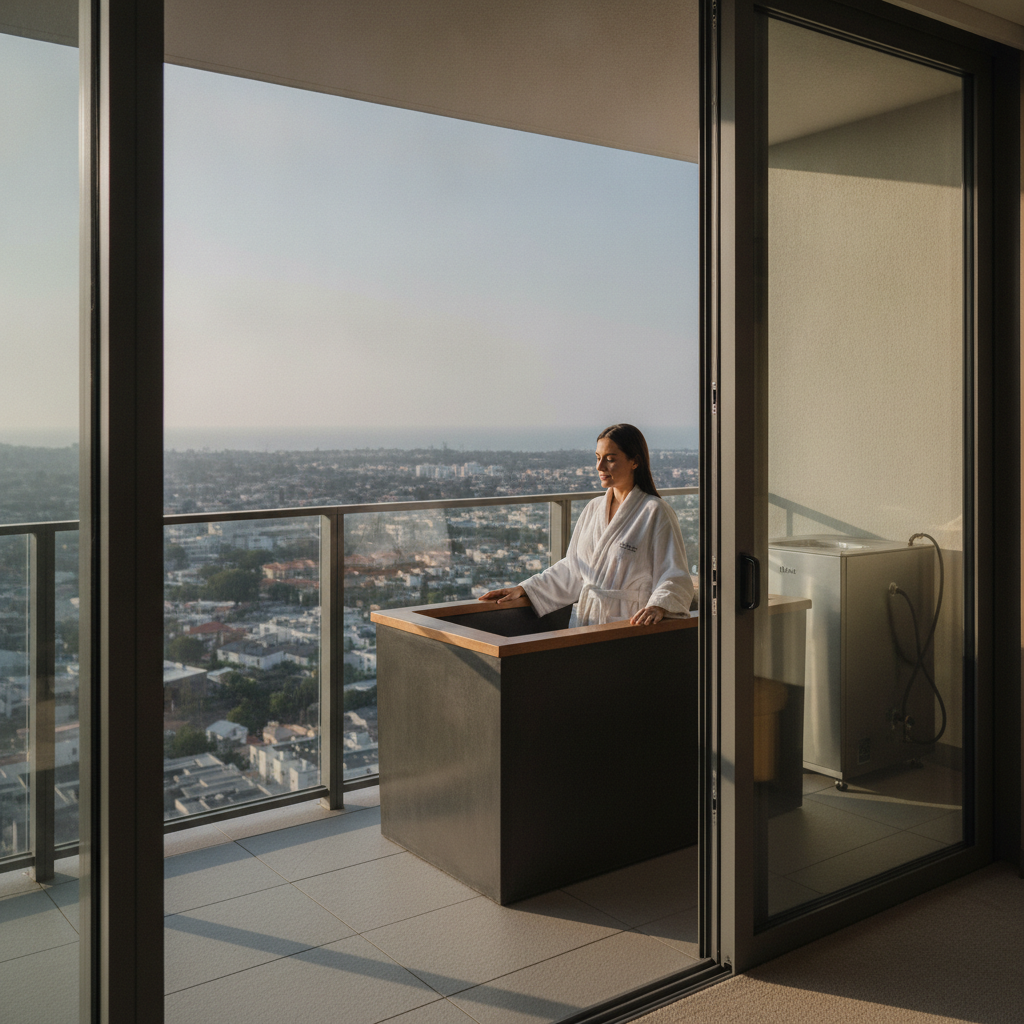
How to add cold plunge to hotel room without plumbing is one of the most common questions facilities directors and spa managers ask once cold immersion moves from spa amenity to in-room guest request. The good news: you don't need a plumber, a permit, or a renovation budget to make it happen. Plug-in chiller systems and portable self-contained tanks now let hotels deliver true 38–55°F cold immersion using nothing more than an existing bathtub, a standard outlet, and a hose. This guide walks through the exact technical process — infrastructure checks, installation steps, staff workflow, and cost — so your engineering and operations teams can execute with confidence.
TL;DR — The Bottom Line
You can add a fully functional cold plunge to a hotel room without any plumbing work by using a plug-in chiller that retrofits the existing bathtub, or a portable self-contained tank that fills and drains via hose. Both methods need only a standard 110V/120V outlet, a floor rated for 800–1,200+ lbs of filled weight, and access to an existing tap or floor drain. Setup takes as little as 10–20 minutes per room, with no permits, no cutting into walls, and no construction downtime.
Quick Facts
- Power required: Standard 110V/120V outlet, ideally on a dedicated 15–20 amp circuit
- Typical setup time: 10–20 minutes per room for a bathtub retrofit chiller
- Floor load requirement: 800–1,200+ lbs filled weight depending on tub or tank size
- Achievable temperature range: 38–55°F (3–13°C)
- Permits/construction needed: None for either method
- Drainage method: Existing tub drain or hose-out to floor drain/hallway drain point
Understanding What "No Plumbing" Really Means in a Hotel Room
Before your engineering team signs off on any installation, it helps to define terms precisely. When operators ask how to add cold plunge to hotel room without plumbing, they typically mean avoiding four specific things: new water lines, new drain lines, wall or floor penetrations, and the permitting process that accompanies wet-trade construction. It does not mean avoiding water entirely.
Every no-plumbing cold plunge solution still uses water — it simply uses the water access that's already in the room. A bathtub retrofit chiller fills the existing tub through the existing tap and drains through the existing tub drain. A portable tank is filled with a hose connected to the bathroom faucet and drained with a submersible pump or gravity hose into the tub or a floor drain. In both cases, the room's existing plumbing does the work; the equipment simply adds refrigeration, filtration, and sanitation on top of it.
This distinction matters because it changes the entire risk and approval profile for the project. Since there's no penetration of building systems, most jurisdictions don't require a plumbing permit, and most hotel engineering teams can approve installation without involving outside contractors. That's the core reason plug-in chiller systems and portable tanks have become the default answer to how to add cold plunge to hotel room without plumbing across boutique and branded properties alike.
The Two Proven Methods for Installing a No-Plumbing Cold Plunge
There are two hardware categories worth understanding when you're mapping out how to add cold plunge to hotel room without plumbing. Each fits different room types and guest volumes.
Method 1: Bathtub Retrofit Chiller Systems
A compact chiller unit sits on the floor beside the existing bathtub. A flexible circulation arm or intake/return hose hangs over the tub edge into the water — no hard seals, no fittings, no cutting. The guest or housekeeping team fills the tub using the existing faucet to roughly two-thirds capacity, plugs the chiller into a standard outlet, and sets a target temperature. The unit continuously chills, filters, and sanitizes the water for the length of the stay, then the tub drains normally when the session or stay ends.
Method 2: Portable Self-Contained Plunge Tanks
These are standalone tubs with integrated chiller and filtration, designed to sit on any flat, adequately rated surface — not just inside a bathroom. They're filled and drained via hose rather than a fixed drain connection, which makes them useful in rooms without a tub, on patios, in gyms, or in converted closets and vestibules. Because they're mobile, properties often rotate a small fleet of units between rooms based on booking demand.
| Factor | Bathtub Retrofit Chiller | Portable Self-Contained Tank |
|---|---|---|
| Best for | Rooms with existing bathtubs | Rooms without tubs, patios, gyms |
| Setup time | 10–20 minutes | 20–30 minutes (fill via hose) |
| Mobility | Chiller unit rolls between rooms; tub stays fixed | Entire unit can be relocated |
| Footprint added | Minimal (uses existing tub) | Moderate (new floor footprint) |
| Drainage | Existing tub drain | Hose-out to drain or tub |
No. Bathtub retrofit chillers use the tub's existing drain, and portable tanks drain via a hose routed into the tub, a shower drain, or pumped out through a window/balcony access point. A dedicated floor drain is helpful but not required for either method.
Room Requirements Checklist Before Installation
Before greenlighting any room for a no-plumbing cold plunge, engineering and operations teams should confirm the following. This checklist is the practical answer to how to add cold plunge to hotel room without plumbing at the property level, not just the product level.
- Electrical: A standard 110V/120V grounded outlet within cord-reach of the tub or tank, ideally not shared with high-draw devices like hair dryers on the same circuit.
- Floor load capacity: The floor under the tub or tank must support the filled weight — typically 800 to 1,200+ lbs depending on unit size — without excessive deflection.
- Clearance: At least 24–30 inches of clear floor space beside the tub for the chiller unit, plus room for a guest to step in and out safely.
- Water access: A functioning tap for fill and an existing drain (tub or floor) for drainage.
- Ventilation: Bathrooms with working exhaust fans to manage ambient humidity from repeated fill/drain cycles.
- Noise tolerance: Most chiller compressors run at 40–55 dB — comparable to a quiet refrigerator — but adjoining walls should be checked if the unit will run overnight.
- Non-slip flooring: Bath mats or slip-resistant surfaces near the tub, given repeated wet entry and exit.
How to Add Cold Plunge to Hotel Room Without Plumbing: A 7-Step Installation Walkthrough
Once a room has cleared the checklist above, the physical process of how to add cold plunge to hotel room without plumbing typically follows seven steps:
- Verify room infrastructure. Confirm outlet location, amperage, floor rating, and drainage access match the checklist requirements.
- Select the installation method. Choose a bathtub retrofit chiller for rooms with existing tubs, or a portable tank for rooms without one.
- Position the unit. Place the chiller or tank in its designated spot, leaving clearance for guest access and cord routing away from walkways.
- Connect power. Plug the unit into the verified outlet; avoid extension cords where possible to maintain electrical safety ratings.
- Fill the tub or tank. Use the existing tap or a fill hose to bring water to the manufacturer-specified level, typically two-thirds full.
- Set temperature and run an initial cycle. Most units reach 38–55°F within 60–90 minutes on first fill; subsequent sessions maintain temperature continuously.
- Test drainage and safety shutoff. Confirm the drain clears fully and that the unit's automatic low-water shutoff functions correctly before the room is released to a guest.
Properties using turnkey hospitality programs, such as those offered through HotelPlunge, typically complete this full walkthrough in under 30 minutes per room, which is why no-plumbing installation has become the standard rollout path for multi-room wellness programs rather than the exception.
Electrical, Drainage, and Floor Load Specs Engineering Teams Should Verify
The technical side of how to add cold plunge to hotel room without plumbing comes down to three specs that engineering teams should document per room before rollout.
Electrical Load
Most compact chiller units draw between 3 and 8 amps continuously, well within a standard 15-amp residential-grade circuit. However, properties with older wiring should confirm the circuit isn't already shared with high-draw bathroom fixtures. A dedicated GFCI-protected outlet is strongly recommended for any bathroom-adjacent electrical equipment.
Drainage Capacity
Existing tub drains handle standard bath water volumes without modification. For portable tanks without a fixed drain, a submersible pump or gravity hose routed to the tub or a floor drain manages drain-down in 5–10 minutes for a typical 40–100 gallon unit.
Floor Load
A filled cold plunge — tub or tank — can weigh 800 to 1,200+ lbs. Most modern hotel bathroom floors, built to support cast-iron or acrylic tubs plus water and occupant weight, already meet this threshold. Older properties or upper floors of wood-frame construction should have engineering confirm joist spacing and load rating before installation, particularly for portable tanks placed outside the bathroom footprint.
Staff Workflow: Fill, Drain, and Turnover Between Guests
Installation is only half the equation. The other half of how to add cold plunge to hotel room without plumbing successfully at scale is building a reliable housekeeping and engineering workflow around it.
- Pre-arrival: Housekeeping fills the tub or tank to the specified level and powers on the chiller 60–90 minutes before check-in so the unit reaches target temperature.
- Mid-stay: Units run continuously with built-in filtration; no manual intervention needed unless the guest requests a temperature change.
- Turnover: On checkout, staff drain the tub via the existing drain (or hose for portable tanks), wipe down the chiller housing, and run a quick sanitation cycle before the next guest.
- Weekly maintenance: Filter checks and descaling per manufacturer guidance, logged by engineering to maintain warranty compliance.
Yes. Because both installation methods rely on existing taps, drains, and standard hoses, routine fill, drain, and turnover tasks fall entirely within normal housekeeping and engineering duties — no outside contractor is required for day-to-day operation.
Cost and Timeline: What to Budget for a No-Plumbing Cold Plunge Rollout
One of the biggest advantages of learning how to add cold plunge to hotel room without plumbing is the compressed budget and timeline compared to spa construction. A single custom-built plumbed plunge pool can take 8–16 weeks and tens of thousands of dollars once permits, demolition, and wet-trade labor are factored in. No-plumbing installations compress that dramatically.
| Approach | Typical Install Time | Permits Required | Relative Cost per Room |
|---|---|---|---|
| Built-in plumbed plunge pool | 8–16 weeks | Yes | High (construction + fixtures) |
| Bathtub retrofit chiller | 10–20 minutes | No | Low–Moderate (equipment only) |
| Portable self-contained tank | 20–30 minutes | No | Moderate (equipment + footprint) |
Because there's no wet-trade labor, no downtime for the room, and no permitting queue, hotels can move from decision to operating cold plunge rooms in days rather than months — a meaningful advantage for properties responding to seasonal wellness demand or competitive pressure from nearby resorts.
Troubleshooting Common Installation and Operational Issues
Even straightforward no-plumbing installations run into a handful of predictable snags. Here's how engineering teams typically resolve them:
- Slow temperature drop: Usually caused by underfilling the tub below the recommended level, restricting circulation. Refill to the manufacturer's minimum line.
- Tripped GFCI outlet: Indicates the unit is sharing a circuit with another high-draw appliance. Move to a dedicated outlet.
- Slow drain: Check for hair or debris buildup in the tub drain trap, a common issue in high-turnover rooms.
- Condensation on bathroom walls: Improve exhaust fan run-time during and after each fill/drain cycle.
- Unit won't power on: Confirm the outlet is live and the low-water safety shutoff isn't engaged due to insufficient fill level.
Most of these issues are resolved by front-line staff in under five minutes, reinforcing why no-plumbing systems remain the most operationally practical answer to how to add cold plunge to hotel room without plumbing across a multi-room rollout.
Frequently Asked Questions
How to add cold plunge to hotel room without plumbing if the room has no bathtub?
Use a portable self-contained plunge tank instead of a bathtub retrofit chiller. These units plug into a standard outlet, fill and drain via hose, and can be positioned on any adequately floor-rated surface, including converted closets, patios, or gym corners.
Does a no-plumbing cold plunge require a special electrical circuit?
Most units run on a standard 110V/120V outlet drawing 3–8 amps, which fits within a typical 15-amp circuit. A dedicated GFCI-protected outlet is recommended but a full electrical upgrade is generally not necessary.
How long does it take to install a no-plumbing cold plunge in a hotel room?
Bathtub retrofit chillers typically install in 10–20 minutes, while portable self-contained tanks take 20–30 minutes including initial fill. Neither requires contractor scheduling or permit approval.
Is a permit needed to add a cold plunge to a hotel room without plumbing?
No. Because these systems use existing taps, drains, and standard electrical outlets rather than new pipe or fixture installation, they typically fall outside the scope of plumbing permits required for construction projects.
Can the same chiller unit be moved between different hotel rooms?
Yes. Most bathtub retrofit chillers include wheels specifically so engineering or housekeeping teams can relocate the unit between rooms based on booking demand, without any fixed installation.
Conclusion: Making the No-Plumbing Cold Plunge Rollout Work for Your Property
Understanding how to add cold plunge to hotel room without plumbing comes down to three practical realities: use the water access you already have, choose the hardware method that fits your room type, and build a simple housekeeping workflow around fill, drain, and turnover. Whether you retrofit existing bathtubs with plug-in chillers or deploy portable self-contained tanks across rooms without tubs, the path from decision to operating amenity can be measured in days, not months — with no permits, no construction crews, and no lost room revenue during installation.
If your property is ready to move forward, HotelPlunge works directly with hotel engineering and spa teams to specify the right no-plumbing configuration for each room type, from single-tub retrofits to full-floor rollouts. Reach out to discuss a room assessment and see how quickly your property can go from checklist to cold plunge.