How to Clean Hotel Cold Plunge Tub: Best Practices Guide
September 25, 2026 · 13 min read
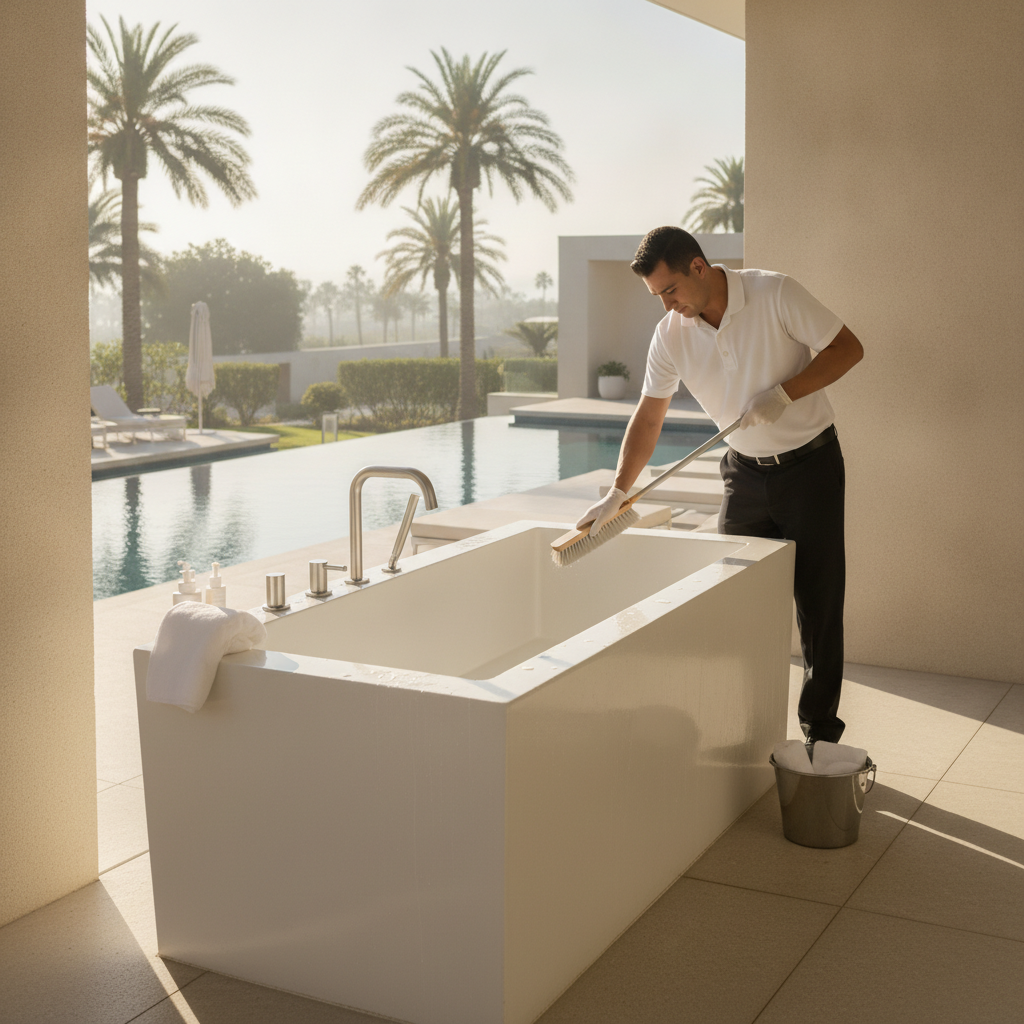
Understanding how to clean hotel cold plunge tub systems correctly is no longer optional — it is a public health, liability, and brand-reputation issue. Unlike a residential ice bath, a hotel cold plunge is a shared aquatic amenity used by dozens of guests per week, often with minimal supervision. Getting the cleaning protocol wrong can lead to waterborne illness outbreaks, regulatory fines, and negative reviews that are far more damaging than a broken jet or a cracked tile. This guide breaks down exactly how to clean hotel cold plunge tub equipment, from daily opening checks to monthly deep cleans, so your property stays compliant, safe, and guest-ready.
TL;DR — The Bottom Line
Learning how to clean hotel cold plunge tub systems properly means treating the unit as a commercial aquatic facility, not a bathtub. That means continuous filtration, a validated disinfectant residual (typically 2.0–7.0 ppm free chlorine or 4.0–10.0 ppm bromine), daily water testing with written logs, pre-entry showers, and scheduled deep cleaning of the shell, cover, jets, and filter media. Non-recirculating tubs must be drained and disinfected between users, which is rarely practical at hotel volume — a hard-plumbed recirculating system with monitored disinfection is the safer, more scalable model.
Quick Facts
- Recommended free chlorine range: 2.0–7.0 ppm (or 4.0–10.0 ppm bromine) for commercial cold plunge operation
- Turnover time target: One hour or less for recirculating systems under MAHC-oriented guidance
- Testing frequency: At minimum, opening, mid-day, and closing for high-traffic hotel amenities
- Non-recirculating tubs: Must be drained, cleaned, and disinfected between each user
- Cold water challenge: Chlorine loses effectiveness at low temperatures, so higher residuals or UV/ozone support are often needed
Why Cleaning a Hotel Cold Plunge Tub Is Different From a Bathtub or Hot Tub
Many general managers assume that if their in-room whirlpool tub cleaning routine works, the same approach applies to a cold plunge. It does not. A hotel cold plunge tub is typically used by multiple guests in sequence over a full day, often without an attendant present. That volume of use, combined with cold water temperatures, creates a distinct set of sanitation challenges that don't apply to a single-guest bathtub.
Cold water is part of the problem. Chlorine and bromine disinfection becomes less effective as water temperature drops, while certain pathogens — including some bacteria and protozoa — can survive longer in cold water than in a heated spa. This means the standard hot-tub cleaning schedule your team already knows is not automatically transferable. Anyone researching how to clean hotel cold plunge tub equipment needs to understand that lower temperatures often require a higher disinfectant residual, secondary treatment such as UV or ozone, or more frequent water testing to compensate.
There's also the question of tub type. Non-recirculating cold plunges — the simple stock-tank or chiller-only units many properties start with — must be drained, scrubbed, and disinfected with an intermediate-level disinfectant between every user. That's manageable for a single-suite installation with an attendant, but it becomes operationally unworkable for a shared spa deck or fitness center seeing 20–40 uses a day. For that volume, a hard-plumbed, recirculating system with continuous filtration and a validated disinfection process is the only realistic path to consistent compliance.
How to Clean Hotel Cold Plunge Tub Units: The Daily Opening Checklist
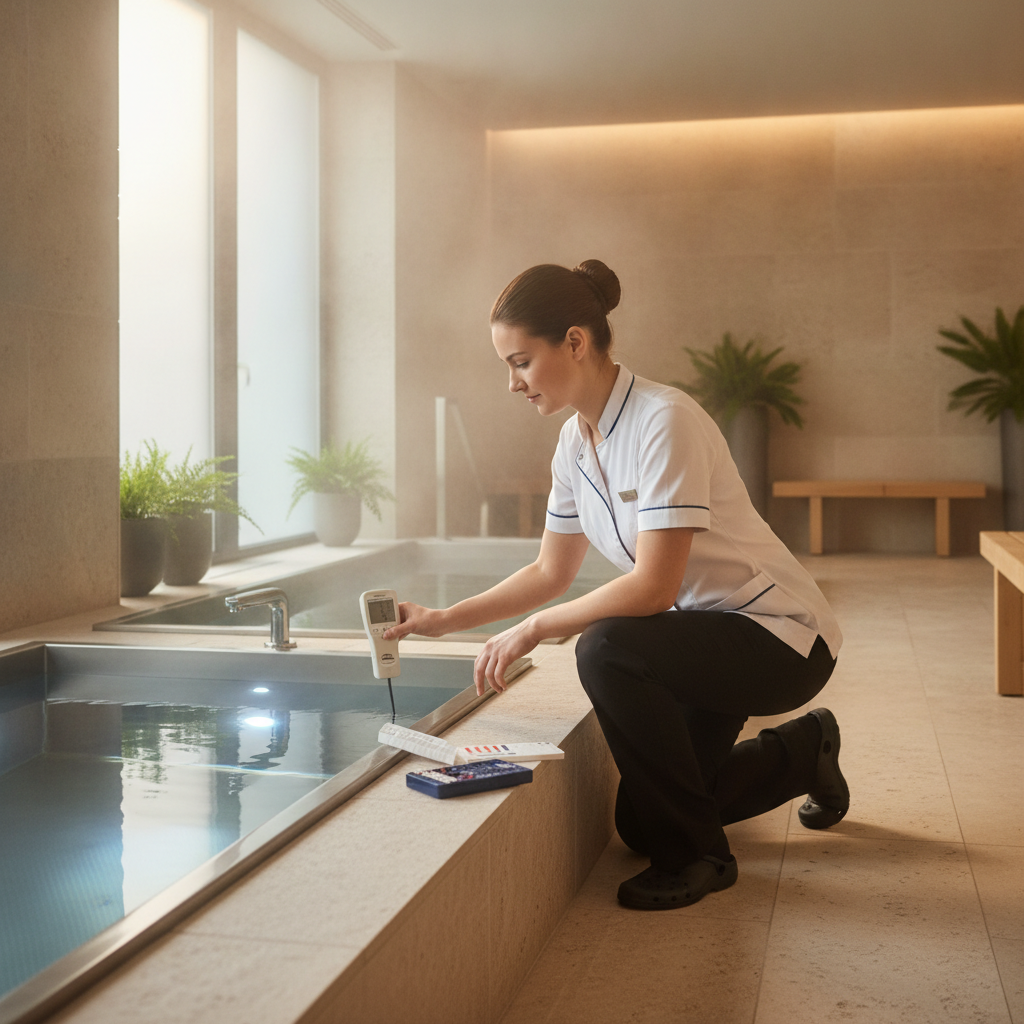
Every operating day should begin with a structured inspection before the first guest steps in. This is the foundation of how to clean hotel cold plunge tub equipment safely and consistently, and it should be documented, not just performed from memory.
- Visual inspection: Check the tub shell, cover, plumbing, drains, grates, jets, skimmer, and filter housing for damage, buildup, or debris.
- Remove debris: Skim and remove any hair, lint, or organic material from the water surface and floor of the tub.
- Confirm equipment function: Verify that circulation pumps, chillers, and any UV or ozone secondary treatment are running correctly.
- Test and record water chemistry: Log free chlorine or bromine, pH, water temperature, and any secondary-treatment readings such as ORP or UV intensity.
- Check water clarity: Water should be clear, odor-free, and free of foam or surface film before opening.
- Inspect safety features: Confirm signage, slip-resistant surfaces, nearby shower access, and emergency equipment are in working order.
Skipping any one of these steps undermines the rest of the program. A property that only tests chemistry but never checks the filter housing, for example, may still end up with cloudy water or a maintenance shutdown mid-shift.
At minimum, test at opening, mid-day, and closing. Higher-traffic amenities or properties without a dedicated attendant benefit from more frequent spot checks, since guest load and organic contamination can change disinfectant demand quickly.
Water Testing and Chemical Standards for Cold Plunge Sanitation
A commercial operating specification commonly cited for cold plunge facilities recommends free chlorine between 2.0 and 7.0 ppm or bromine between 4.0 and 10.0 ppm, along with a turnover time of one hour or less, consistent with guidance modeled on the CDC's Model Aquatic Health Code. These are not universal legal minimums — your local health department and equipment manufacturer specifications take precedence — but they represent a reasonable operating band for properties without a more specific local standard.
Because cold water reduces disinfectant efficiency, many spa directors ask how to clean hotel cold plunge tub water without over-chlorinating it. The answer usually involves supplementing chlorine or bromine with a secondary treatment method — UV, ozone, or sub-micron filtration — rather than simply increasing chemical dosing to uncomfortable levels for guests. The CDC's 2024 Model Aquatic Health Code specifies pathogen-inactivation performance requirements for UV and ozone systems, so any secondary treatment installed must still meet documented performance standards, not just be present as a marketing feature.
| Parameter | Recommended Range | Testing Frequency |
|---|---|---|
| Free chlorine | 2.0–7.0 ppm | Opening, mid-day, closing |
| Bromine (alternative) | 4.0–10.0 ppm | Opening, mid-day, closing |
| pH | 7.2–7.8 (typical) | Opening, mid-day, closing |
| Turnover time | 1 hour or less | Verified at setup, monitored ongoing |
Every log entry should include the time, the reading, the corrective action taken if a value fell outside range, and the initials of the staff member who performed the test. This documentation is what protects a property during a health department inspection or a guest incident review — and it's the single most overlooked piece of how to clean hotel cold plunge tub programs at properties that otherwise have the right equipment.
During-Service Cleaning: What Staff Should Do Between Guests
Even with a well-maintained recirculating system, staff still play an active role during operating hours. Understanding how to clean hotel cold plunge tub surfaces between uses — not just the water itself — is what keeps the amenity looking and feeling fresh throughout the day.
- Remove hair, lint, leaves, and other visible debris as soon as it's noticed, not just at scheduled checks.
- Wipe and disinfect high-touch surfaces: handrails, steps, ladders, control panels, benches, and nearby shower fixtures.
- Enforce a mandatory pre-entry shower for every guest — this single step significantly reduces the organic load (sweat, lotion, sunscreen) that disinfectant has to work against.
- Prohibit oils, lotions, glass containers, food, and beverages at the tub area.
- Pause use immediately if water becomes cloudy, disinfectant readings fall outside the accepted range, circulation stops, or there is a fecal, vomit, blood, or chemical contamination incident.
Properties that treat these steps as optional often see faster degradation of water clarity and a higher chemical demand later in the day, which drives up both labor and chemical costs.
End-of-Day Deep Cleaning and Filter Maintenance
The closing routine is where most of the physical scrubbing happens, and it's arguably the most important part of how to clean hotel cold plunge tub equipment for long-term hygiene and equipment life.
- Remove and clean the cover: Never set a contaminated cover directly on the floor — clean it on a surface or hang it to dry.
- Scrub the waterline and interior: Brush or wipe the waterline, walls, seats, steps, jets, and fittings using a cleaner compatible with the tub's shell material (acrylic, stainless steel, or composite).
- Clean the surrounding deck and drainage area: Standing water and organic buildup around the tub base is a common source of slip hazards and odor complaints.
- Service the filtration system: Backwash, rinse, or replace filter media according to the pressure differential and manufacturer schedule, not just a fixed calendar date.
- Re-test and log closing chemistry: Record final readings before locking down the area for the night.
Filter neglect is one of the fastest ways to undermine an otherwise solid program. A clogged or overdue filter reduces turnover efficiency, which in turn increases the disinfectant demand needed to keep the water safe — a cycle that drives up both cost and risk.
Weekly and Monthly Deep-Cleaning Protocols
Daily and closing routines address surface-level hygiene, but a complete answer to how to clean hotel cold plunge tub systems also requires a longer-cycle maintenance calendar.
Weekly tasks
- Inspect and clean skimmer baskets and strainer baskets thoroughly.
- Check calibration of test kits or automated chemical controllers.
- Review the week's water chemistry log for patterns — recurring pH drift or chlorine demand spikes often point to a mechanical or usage issue.
Monthly tasks
- Deep-clean or replace filter cartridges/media according to manufacturer guidance.
- Inspect seals, gaskets, and plumbing connections for wear or leaks.
- Audit staff logs and retrain any team members with inconsistent testing or documentation habits.
- Schedule a professional service visit for chillers, pumps, and any UV or ozone equipment.
Basic tasks like debris removal and surface wiping can be handled by trained housekeeping or maintenance staff, but water testing, chemical dosing, and filtration troubleshooting should be performed by staff who have completed pool/spa operator training or an equivalent certification, since incorrect chemical handling creates both safety and liability risks.
Common Mistakes That Put Hotels at Risk
Even well-intentioned properties make errors that undermine an otherwise sound approach to how to clean hotel cold plunge tub equipment. The most frequent issues include:
- Treating it like a bathtub: Assuming housekeeping's standard bathroom cleaning checklist is sufficient for a shared aquatic amenity.
- Under-testing cold water: Failing to account for reduced chlorine efficacy at low temperatures, leading to a false sense of security from a single daily reading.
- No written log: Relying on memory instead of documented, time-stamped water chemistry records that would hold up in a health inspection.
- Ignoring the cover and deck: Focusing only on the water while neglecting the cover, surrounding floor, and high-touch surfaces where pathogens and mold can accumulate.
- Delayed filter service: Running filters past their recommended service interval, which reduces turnover efficiency and increases disinfectant demand.
- No pre-entry shower policy: Allowing guests to enter without rinsing off, which significantly increases the organic contaminant load in the water.
Any one of these gaps can turn a well-designed cold plunge amenity into a liability. The good news is that each one is fixable with a documented protocol and consistent staff training — which is exactly what a structured cleaning program is designed to prevent.
Building a Cleaning Log and Staff Training Program
Knowing how to clean hotel cold plunge tub equipment on paper is only half the job — the other half is making sure every shift executes it the same way. A written or digital log should capture, at minimum, the time of each check, the specific readings taken, any corrective action performed, and the initials of the staff member responsible. This creates an audit trail that protects the property if a guest complaint or health inspection ever occurs.
Training should cover not just the mechanics of testing water chemistry, but the reasoning behind each step — why cold water changes disinfection needs, why pre-entry showers matter, and what symptoms (cloudy water, unusual odor, excessive foam) should trigger an immediate shutdown rather than a "we'll check it later" response. Properties that invest in this level of training tend to have fewer equipment failures and far fewer guest complaints tied to water clarity or odor.
For hotels evaluating new cold plunge installations or looking to upgrade an aging system to something easier to maintain, HotelPlunge works with properties to specify commercial-grade recirculating systems designed around real-world hotel operating conditions, not just showroom aesthetics. A tub that's engineered for consistent filtration and simplified maintenance makes every step of how to clean hotel cold plunge tub equipment easier for your team.
Frequently Asked Questions
How often should a hotel clean its cold plunge tub?
Recirculating systems need daily inspection, water testing, and surface wiping, plus weekly and monthly deep-cleaning tasks like filter servicing and equipment calibration checks. Non-recirculating tubs must be drained and disinfected between each individual user, which is why most hotels with shared amenities move to a recirculating model.
What chemicals are used to clean a hotel cold plunge tub?
Most commercial cold plunges use free chlorine (typically 2.0–7.0 ppm) or bromine (4.0–10.0 ppm) as the primary disinfectant, often supported by secondary treatment such as UV or ozone to compensate for reduced chlorine effectiveness in cold water. The exact chemical program should follow local health code requirements and equipment manufacturer specifications.
Is cleaning a cold plunge tub different from cleaning a hot tub?
Yes. Cold water reduces the efficacy of standard chlorine disinfection while allowing some pathogens to survive longer, so cold plunge tubs often require higher disinfectant residuals or additional secondary treatment compared to a heated spa operating at the same chemical levels.
Do guests need to shower before using a hotel cold plunge tub?
Yes, a mandatory pre-entry shower is a standard best practice. It significantly reduces the organic contaminant load — sweat, lotion, sunscreen — that the disinfectant system has to neutralize, and it's a core part of any compliant program for how to clean hotel cold plunge tub water effectively.
Who is responsible for maintaining hotel cold plunge tub cleanliness?
Typically, spa or wellness directors oversee the protocol while trained maintenance or spa staff execute daily testing and cleaning. Larger properties often designate a certified pool/spa operator to manage chemical dosing and equipment troubleshooting, since incorrect handling carries both safety and regulatory risk.
Conclusion: Make Cold Plunge Cleaning a Documented System, Not a Habit
Guests expect a cold plunge to feel invigorating, not risky. Learning how to clean hotel cold plunge tub systems properly — with daily testing, documented logs, pre-entry shower policies, and scheduled deep cleaning — is what separates a well-run wellness amenity from a liability waiting to surface. The properties that get this right treat their cold plunge the same way they'd treat a pool or hot tub: as a commercial aquatic facility governed by local health code, not an oversized bathtub.
If your property is evaluating a new installation or looking to simplify maintenance on an existing unit, HotelPlunge can help you select a system built for reliable filtration, easier daily upkeep, and long-term compliance. Reach out to discuss which configuration fits your property's volume, staffing model, and wellness program goals.