Cold Therapy for Hotel Guest Recovery: A GM's Guide
October 22, 2026 · 13 min read
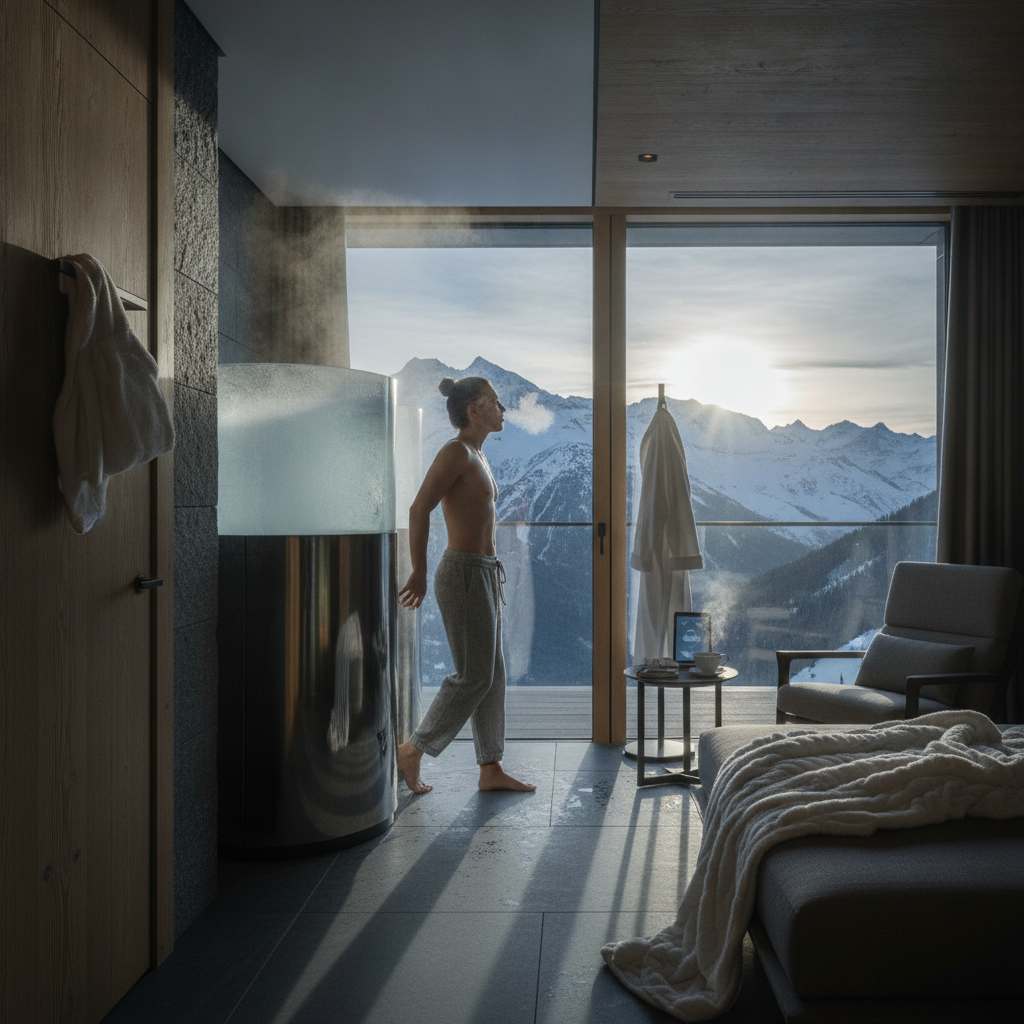
Guests arrive tired. They land after red-eye flights, push through back-to-back meetings, or finish a punishing trail run before checkout. Cold therapy for hotel guest recovery has emerged as one of the fastest-growing responses to that reality, moving from fringe biohacking circles into mainstream hospitality programming at resorts, boutique hotels, and urban business properties alike. For General Managers, Spa and Wellness Directors, and property owners evaluating what comes after the sauna and the infrared mat, cold therapy represents a rare amenity that is simultaneously experiential, differentiating, and operationally manageable.
This article is not a product review or a renovation guide. Instead, it examines the why now behind cold therapy for hotel guest recovery, who is actually using it, how to build a program guests trust, and how to position the amenity responsibly without overstating the science.
TL;DR — The Bottom Line
Cold therapy for hotel guest recovery is shifting from a niche spa add-on to a mainstream wellness amenity, driven by a $6.8 trillion global wellness economy and a cold-plunge market projected to nearly double by 2033. Hotels succeed with cold therapy when they position it as a recovery and ritual experience — supported by screening, guided protocols, and hot-cold circuits — rather than as an unsupervised tub or a medical treatment.
Quick Facts
- Global wellness economy: $6.8 trillion in 2024
- Wellness tourism spending: approximately $893.9 billion in 2024, 13.2% of total wellness spend
- Cold plunge tub market size: $354.6 million in 2025, projected to reach $659.9 million by 2033 (8.1% CAGR)
- Luxury travelers citing wellness as important: 90% in 2025, up from 80% in 2024
- Wellness travel recovery vs. 2019: spending at 136%, trip volume at 133%
What Is Cold Therapy for Hotel Guest Recovery?
Before building a program, it helps to define the term precisely, since hotel teams often use it loosely to describe anything from an ice bucket to a fully chilled plunge tank.
Within hospitality, cold therapy for hotel guest recovery usually takes one of three forms: a standalone commercial plunge tub near the fitness center or spa, a contrast circuit that pairs cold immersion with sauna or steam, or an in-suite unit positioned as a premium room feature. Each format serves a different guest segment and a different revenue model, which is why operators should treat cold therapy less like a single piece of equipment and more like a guest journey with a beginning, middle, and end.
It's worth being precise about what cold therapy for hotel guest recovery is not. It is not a verified treatment for illness, a guaranteed immunity booster, or a substitute for medical care. Responsible hotel programming avoids these claims entirely and instead leans into the experience itself: the ritual, the shared moment, the post-plunge glow that guests want to photograph and talk about at dinner.
Why Cold Therapy for Hotel Guest Recovery Is Becoming a Must-Have Amenity
Three forces are converging to push cold therapy for hotel guest recovery from novelty to necessity.
1. Wellness has become a mainstream booking driver, not a luxury footnote
The global wellness economy reached an estimated $6.8 trillion in 2024, with wellness tourism accounting for roughly $893.9 billion of that total — about 13.2% of all wellness spending. Wellness travel has not just recovered from the pandemic; it has overshot it, with spending at 136% and trip volume at 133% of 2019 levels. Among luxury travelers specifically, 90% surveyed in 2025 said wellness offerings were important to their booking decision, up sharply from 80% just a year earlier. Hotels that treat wellness as a peripheral spa menu item, rather than a core part of the guest journey, are increasingly out of step with what travelers now expect.
2. Cold plunges fit the modern definition of "recovery" travel
Today's traveler is rarely purely a tourist or purely a business guest. They are runners squeezing in a morning session before a conference, parents decompressing after a long travel day with kids, or wellness-trip guests who booked the stay specifically for recovery. Cold therapy for hotel guest recovery speaks directly to this blended guest profile because it addresses a felt need — tired legs, poor sleep, travel stress — rather than an abstract wellness concept.
3. The amenity is highly visible and shareable
Unlike many back-of-house wellness investments, a cold plunge is something guests can see, try, and post about. That visibility compounds the return on a relatively contained capital investment, turning a single amenity into marketing content, a press angle, and a reason for local residents to book a day pass.
The underlying demand driver — wellness as a primary travel motivator — has been growing steadily since before the pandemic and has since exceeded 2019 levels. Cold therapy specifically benefits from strong evidence around short-term stress reduction, relaxation, sleep quality, and muscle soreness relief, which gives it more durability than amenities built on unproven claims.
The Guest Recovery Journey: Who Actually Uses Cold Therapy at Hotels
Understanding guest segments helps GMs and Spa Directors design cold therapy for hotel guest recovery around real behavior instead of a generic spa-menu listing.
- The athletic traveler: Runners, cyclists, and gym-goers who use the property's fitness center and want post-workout recovery, often at specific times of day tied to their training schedule.
- The business-travel decompressor: Guests coming off long flights or packed meeting schedules who want a fast reset before dinner or an early flight home.
- The wellness-trip guest: Travelers who booked the stay specifically because of the property's recovery and spa programming, often willing to pay for guided, multi-step experiences.
- The couple or small group: Guests treating cold therapy as a shared activity and photo moment, frequently paired with sauna, steam, or a spa treatment.
- The curious first-timer: Guests who have heard about cold plunging but never tried it, and who need clear instructions, time limits, and reassurance to feel comfortable.
Segmenting guests this way clarifies why cold therapy for hotel guest recovery performs best when it is programmed with reservation windows, posted guidance, and optional staff support rather than treated as a self-serve fixture with no structure.
Designing a Cold Therapy for Hotel Guest Recovery Program That Guests Trust
Equipment alone does not create a successful amenity. The operators seeing the strongest guest response treat cold therapy for hotel guest recovery as a designed experience with clear steps.
Building the hot-cold circuit
The strongest hospitality model pairs cold immersion with heat — sauna, steam, or a heated pool — in a structured circuit. A typical guided sequence looks like this:
- Warm-up: 10–15 minutes in sauna or steam to raise core temperature and prepare the body.
- Cold immersion: 1–3 minutes in the plunge, with posted guidance recommending first-timers start closer to 30–60 seconds.
- Recovery rest: 5–10 minutes of seated rest, hydration, and breathing before repeating or ending the circuit.
- Repeat: Experienced guests may cycle through two to three rounds, always finishing on a rest period rather than cold immersion.
This structure gives cold therapy for hotel guest recovery a clear beginning and end, which reduces guest uncertainty and gives staff an easy script to explain the experience at check-in or at the spa desk.
Signage, timing, and reservations
Clear signage with recommended immersion times, contraindications, and a simple house rule (no jewelry, no alcohol beforehand, no solo late-night use) does more to protect both guests and the property than any single piece of equipment. Reservation slots, even informal ones through a spa app or front-desk sign-up sheet, also help manage demand during peak morning and evening hours.
Safety, Screening, and Staff Protocols for Cold Therapy for Hotel Guest Recovery
Liability and guest wellbeing concerns are the top reason some operators hesitate on cold therapy for hotel guest recovery. A disciplined operating protocol addresses most of these concerns directly.
Pre-use screening
Posted or verbal screening should flag conditions where cold immersion is not advisable, including cardiovascular conditions, pregnancy, Raynaud's phenomenon, uncontrolled high blood pressure, and recent alcohol consumption. A simple laminated card at the plunge, plus a brief mention from spa or fitness staff, covers most of this without requiring a full medical intake.
Water quality and sanitation
Commercial cold plunges require filtration and sanitation systems comparable to a small spa pool — not simply periodic manual draining. Daily water testing logs, chemical balance checks, and a documented cleaning schedule protect both guest health and the property's liability position.
Staff training
Front desk, spa, and fitness staff should all be able to explain basic use guidelines, recommended duration, and what to do if a guest reports dizziness or discomfort. This does not require clinical training — it requires a short, standardized script and periodic refreshers.
No. Most properties manage cold therapy safely through posted screening guidance, staff training, and clear time limits, the same approach used for saunas and steam rooms. A medical professional is not required for general hospitality use, though properties should still avoid making medical claims about the amenity's benefits.
How Cold Therapy for Hotel Guest Recovery Compares to Other Wellness Amenities
Positioning cold therapy correctly means understanding where it sits relative to the rest of a property's wellness stack.
| Amenity | Guest motivation | Typical usage pattern | Fit with cold therapy |
|---|---|---|---|
| Sauna / steam room | Relaxation, warmth, detox feeling | Daily, often evening | Natural pairing for a hot-cold circuit |
| Fitness center | Training, maintaining routine while traveling | Morning, pre- or post-workout | Strong overlap — athletic travelers want recovery after training |
| Spa treatments (massage, facials) | Pampering, indulgence | Scheduled, often one-time per stay | Complementary add-on; cold plunge can precede or follow a treatment |
| Cold therapy for hotel guest recovery | Physical recovery, stress relief, novelty experience | Short sessions, often repeated across a multi-night stay | Highest repeat-use potential among wellness amenities |
The repeat-use pattern is particularly important for owners evaluating amenity investments. A spa massage is typically a once-per-stay purchase, while cold therapy for hotel guest recovery can be used multiple times across a single visit, increasing both guest satisfaction and the perceived value of a wellness package.
Positioning and Marketing Cold Therapy for Hotel Guest Recovery Without Overclaiming
How a property talks about cold therapy for hotel guest recovery matters as much as the equipment itself. The scientific evidence currently supports cold-water immersion for short-term stress reduction, subjective relaxation, improved sleep quality, and reduced post-exercise muscle soreness. Evidence for broader claims — disease prevention, immune system strengthening, or long-term health transformation — remains inconclusive and should not appear in marketing copy, signage, or staff scripts.
This distinction protects the property legally and also tends to build more durable guest trust. Experienced wellness travelers are often skeptical of overstated health claims, but they respond well to honest, experience-forward language: "a bracing reset after your workout," "a signature part of our recovery circuit," or "a ritual our guests return for night after night."
Cold therapy for hotel guest recovery works best as a hospitality story, not a medical pitch. Properties that lead with guest experience — the shared laugh after the first plunge, the calm that follows a hot-cold circuit before bed — tend to generate stronger word-of-mouth and social sharing than those that lean on clinical language.
For hotels exploring how to introduce this amenity without a full renovation cycle or a large capital outlay, working with a dedicated hospitality partner like HotelPlunge can simplify both the equipment selection and the guest-facing presentation, since the goal is a cohesive experience rather than an isolated piece of equipment.
No. Hospitality marketing should focus on the experience — relaxation, recovery, ritual, and novelty — rather than medical claims such as immunity benefits or disease prevention, since the supporting research for those broader claims is not yet conclusive.
What the Competitive Landscape Tells Hotels About Cold Therapy Demand
The presence of cold therapy for hotel guest recovery at well-known properties — including wellness-forward resorts, fitness-branded hotels, and luxury urban properties — signals that this amenity has moved past the experimental stage. When flagship brands in the Ritz-Carlton and Four Seasons orbit, along with fitness-focused concepts like Equinox Hotel, incorporate cold plunges into their wellness programming, independent and mid-scale operators gain a clearer signal that guest demand is broad rather than confined to a handful of ultra-luxury outliers.
For ownership groups evaluating whether to commit budget to cold therapy for hotel guest recovery, this competitive context matters: the amenity is no longer a speculative bet on an emerging trend, but a response to an already-validated guest expectation in the upper tiers of the market, now extending into broader hospitality segments.
Frequently Asked Questions
What is cold therapy for hotel guest recovery?
It is the structured use of cold-water immersion, typically between 39°F and 55°F, offered as a hotel amenity to support stress reduction, relaxation, sleep quality, and post-exercise muscle recovery, delivered through guided protocols rather than unsupervised access.
Is cold therapy safe for all hotel guests?
Not universally. Guests with cardiovascular conditions, uncontrolled high blood pressure, Raynaud's phenomenon, or who are pregnant should avoid cold immersion or consult a physician first. Posted screening guidance and staff awareness help properties manage this responsibly.
How long should a hotel cold plunge session last?
Most guided protocols recommend 1 to 3 minutes for experienced users and closer to 30 to 60 seconds for first-timers, often as part of a hot-cold circuit that begins with sauna or steam and ends with a rest period.
Does cold therapy for hotel guest recovery actually improve guest wellbeing?
Evidence supports short-term benefits including stress reduction, subjective relaxation, improved sleep quality, and reduced post-exercise muscle soreness. Evidence for broader claims such as immunity benefits or disease prevention remains inconclusive, so hotels should avoid making those specific promises.
What guest segments use hotel cold plunges most?
Athletic travelers recovering from workouts, business travelers decompressing from flights or packed schedules, dedicated wellness-trip guests, couples seeking a shared activity, and curious first-timers trying the experience for the first time.
Conclusion: Building Cold Therapy for Hotel Guest Recovery the Right Way
Cold therapy for hotel guest recovery sits at the intersection of two durable trends: a wellness economy that has grown to $6.8 trillion globally, and a traveler base that increasingly books based on recovery and reset rather than sightseeing alone. The properties that will win with this amenity are not necessarily the ones with the most expensive tank, but the ones that build a complete experience — guided circuits, clear screening, trained staff, and honest, experience-forward marketing.
For hotel leaders ready to move from evaluating the trend to planning an actual program, the next step is matching the right equipment and operating model to your property's guest mix, space, and service style. HotelPlunge works with hotel teams to turn cold therapy for hotel guest recovery from a concept on a wellness trend report into a daily, revenue-supporting part of the guest journey.