Vendor Selection for Hotel Cold Plunge: A Buyer's Guide
October 8, 2026 · 13 min read
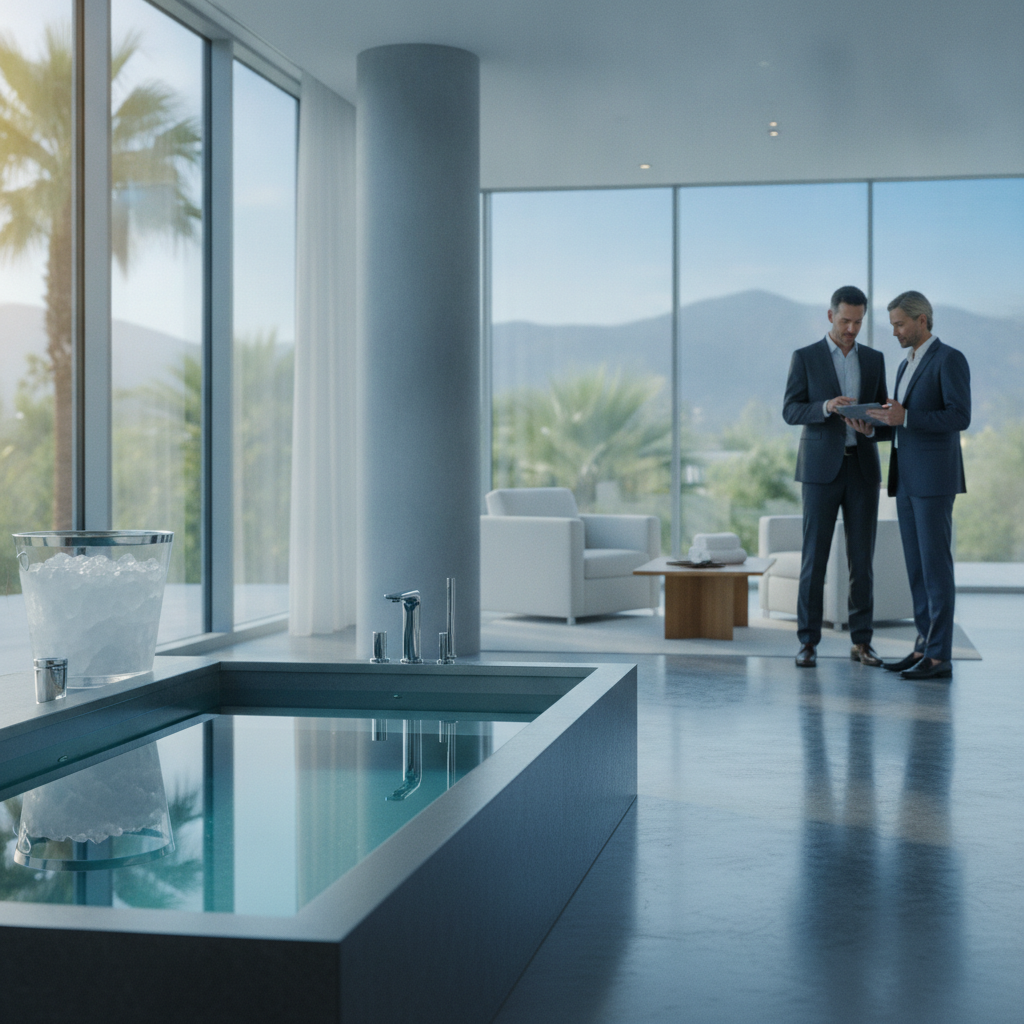
Vendor selection for hotel cold plunge programs is rarely treated with the rigor it deserves. Many properties approach the decision the way they'd buy a treadmill — compare prices, pick a finish color, place the order. But a cold plunge installed for shared guest use is a piece of commercial water equipment operating under regulatory scrutiny, daily wear, and guest-safety expectations. Getting vendor selection for hotel cold plunge programs wrong doesn't just waste capital — it can create liability exposure, service outages, and guest complaints that undercut the entire wellness positioning a property is trying to build.
This guide breaks down what hotel general managers, spa and wellness directors, and property owners should actually evaluate before signing a contract, and why the right partner matters more than the right product spec sheet.
TL;DR — The Bottom Line
Vendor selection for hotel cold plunge equipment should be judged on commercial-grade durability, documented water-sanitation compliance, service and uptime guarantees, and a credible revenue model — not just purchase price or design appeal. Hotels running shared-use plunges generally need continuous recirculation, a measurable halogen residual, and turnover rates of one hour or less, per CDC Model Aquatic Health Code guidance.[1] The strongest vendors behave like hospitality operating partners rather than equipment sellers.
Quick Facts
- Global wellness economy (2024): approximately $6.8 trillion, up 7.9% from 2023[2]
- Wellness tourism spend (2024): nearly $900 billion globally[2]
- Wellness traveler trips (2024): roughly 1.24 billion domestic and international trips[3]
- Global hotel cold-plunge-pod market (2025 est.): approximately $1.8 billion, projected to reach $4.2 billion by 2034[4]
- CDC recommended chlorine range for spa-classified cold plunges: 2.0–7.0 ppm free chlorine (or 4.0–10.0 ppm bromine), with turnover of one hour or less[1]
What Is Vendor Selection for Hotel Cold Plunge Equipment?
Before comparing suppliers, it helps to define the term precisely, because vendor selection for hotel cold plunge programs covers far more than picking a model.
This matters because the vendor you choose will effectively become a long-term operational partner. Equipment needs chillers serviced, filters replaced, water chemistry monitored, and staff trained. A vendor that disappears after installation is not a vendor selection for hotel cold plunge decision — it's a one-time transaction that leaves the property holding all the operational risk.
Commercial-Grade Performance: The First Filter
A residential cold plunge might see one or two sessions a day. A hotel unit in a wellness suite, gym, or spa corridor can see dozens of users daily, often back-to-back during peak morning and evening hours. This single difference should dominate early vendor selection for hotel cold plunge conversations.
Ask every vendor under consideration to document, in writing:
- Maximum recommended sessions per day and per hour
- Chiller recovery time between consecutive users
- Stable operating temperature under sustained peak demand
- Filtration flow rate and water turnover time
- Expected equipment lifespan under commercial, not residential, use
- Noise and heat output in enclosed guest spaces
- Documented performance in your property's ambient climate
- Lead times and availability for replacement pumps, chillers, filters, and sensors
Consumer-grade equipment is generally engineered for intermittent personal use, not the continuous-duty cycle hotels require.[5] A credible vendor should be able to produce references from comparable hotels, resorts, athletic clubs, or commercial spas — not exclusively residential customers. If a sales representative can't name a single hotel client, that's a meaningful gap in your vendor selection for hotel cold plunge due diligence.
Answer: Technically yes, but it's rarely advisable. Residential units are not built for continuous-duty cycling, commercial filtration turnover, or the sanitation documentation that shared-use installations typically require. Most vendors experienced in hospitality will steer hotels toward commercial-rated systems specifically to avoid premature equipment failure and compliance gaps.
Water Sanitation and Regulatory Compliance
Water hygiene is arguably the single most important factor in vendor selection for hotel cold plunge programs, and it's the one most often underweighted by buyers focused on aesthetics or app features.
The CDC's Model Aquatic Health Code treats cold-water structures that are not drained between every user as spas, which brings them under recognized public-health standards.[1] According to that guidance, applicable installations generally need:
- Continuous recirculation and filtration
- A documented sanitation system with measurable halogen residual (2.0–7.0 ppm free chlorine or 4.0–10.0 ppm bromine)
- Water turnover of one hour or less
- Ongoing pH monitoring and logging
- Written cleaning and shock-treatment procedures
- Safe drainage and refill protocols
- Documented staff training and escalation steps
Notably, ultraviolet light or hydrogen peroxide alone should not be accepted as a substitute for a measurable halogen residual where one is required.[1] Any vendor who tells you UV sterilization is "all you need" for a shared-use hotel plunge is giving guidance that may not meet recognized public-health code — a critical red flag in vendor selection for hotel cold plunge decisions.
It's also worth stress-testing the fill-and-drain model some vendors propose as a simpler alternative. A tub that's drained, cleaned, disinfected, refilled, and brought back to temperature after every guest may sound appealing on paper, but at real hotel volume this workflow can become operationally unworkable unless the property commits to strict one-user-at-a-time scheduling and dedicated staffing.[1] Before signing anything, require the vendor to identify exactly which sanitation code or standard their system is designed to meet, and ask for it in writing.
Service, Support, and Uptime: The Hidden Cost Center
An out-of-service cold plunge is worse than no cold plunge at all — it's a visible, often photographed, broken promise to guests who booked a wellness-forward room or spa package expecting a working amenity. Uptime should be treated as a core metric in vendor selection for hotel cold plunge negotiations, not an afterthought buried in a warranty clause.
Questions worth asking directly:
- What is the guaranteed response time for a service call, and does it vary by region?
- Does the vendor stock common replacement parts, or are they special-ordered from overseas?
- Is there a remote monitoring system that flags chiller or filtration issues before guests notice?
- What is included in the standard warranty, and what requires a paid service contract?
- Who performs water testing and chemical logging — vendor staff, a third party, or hotel engineering?
Independent maintenance providers exist specifically because many equipment vendors stop short of ongoing service.[6] That's a reasonable model for some properties, but it also means two vendor relationships to manage instead of one, and two points of potential failure if something goes wrong at 11 p.m. on a Saturday.
Answer: No. Acquisition cost is only one line item. Service response time, parts availability, water-compliance support, and staff training typically determine whether a cold plunge program actually stays operational and profitable over a multi-year period, which matters more to guest experience and ROI than the initial invoice.
Vendor Business Models: Hardware Seller vs. Hospitality Partner
The competitive landscape for hotel cold plunge equipment is fragmented, and understanding which category a vendor falls into is a practical shortcut in vendor selection for hotel cold plunge evaluations.
| Vendor type | Typical strength | Typical gap |
|---|---|---|
| Premium consumer brands moving into commercial | Brand recognition, polished design, app controls | Limited hotel-specific compliance documentation and multi-property service history |
| Commercial-focused plunge manufacturers | Larger systems, installation options, business-oriented sales process | Service models and independent performance evidence can be inconsistent |
| High-performance / extreme-temperature systems | Durability, very low temperatures, athlete appeal | Higher acquisition cost; may exceed what most hotel guest programs require |
| Value and private-label suppliers | Low upfront pricing, configuration flexibility | Uncertainty around certification, warranty, and long-term parts availability |
| Independent service companies | Recurring maintenance, water testing, compliance logs | Usually don't supply equipment, installation, or revenue strategy |
| Hospitality operating partners | End-to-end equipment, compliance, installation, service, and revenue support | Fewer providers currently offer this complete model |
Most hotels discover, often after a difficult first year, that the strongest outcome comes from working with a provider that behaves like the last row in that table — a partner accountable for the full lifecycle, not just the hardware. That's the core premise behind HotelPlunge's approach to vendor selection for hotel cold plunge programs: treat the plunge as a managed hospitality amenity, not a standalone appliance.
A Practical Due-Diligence Framework
Use the following sequence to structure vendor selection for hotel cold plunge conversations before any contract is signed.
- Define the use case first. Decide whether the plunge will serve an in-suite program, a fitness-center recovery station, or a spa-anchored contrast-therapy circuit — the answer changes which equipment specs and sanitation workflow make sense.
- Request commercial duty-cycle documentation. Ask for written session limits, recovery times, and lifespan data under continuous hotel use, not residential marketing claims.
- Confirm the sanitation standard in writing. Require the vendor to name the specific code or guideline their system is designed to satisfy, and verify halogen residual and turnover claims against CDC Model Aquatic Health Code benchmarks.[1]
- Audit the service model. Get response-time guarantees, parts-stocking details, and remote-monitoring capability in the proposal, not just verbally from a sales rep.
- Check references at comparable properties. Call at least two or three hotels or resorts of similar size and guest profile that have used the vendor for 12+ months.
- Model the revenue and cost picture together. Compare acquisition cost, service contracts, water-chemical consumables, and expected utilization against the amenity's contribution to room rate, package sales, or ancillary spa revenue.
- Negotiate accountability, not just price. Build uptime guarantees, compliance support, and staff-training obligations into the contract itself.
Answer: Most properties should budget four to eight weeks for a thorough review, including reference calls, compliance document review, and a site visit or video walkthrough of a comparable installation. Rushing this process to meet a marketing launch date is one of the most common causes of post-installation regret.
Red Flags and Myths in Vendor Selection
Several recurring misconceptions quietly derail vendor selection for hotel cold plunge decisions. Watch for these warning signs during vendor conversations:
- Reluctance to provide written sanitation or compliance documentation
- No hotel, resort, or commercial-spa references available
- Vague or evasive answers about chiller recovery time under repeated use
- Service contracts that exclude parts, labor, or water-chemical replenishment without clear disclosure
- Pressure to sign quickly without a documented pilot or trial period
The wellness travel market backs up why this diligence is worth the effort. Wellness tourism generated nearly $900 billion in 2024 and wellness travelers took approximately 1.24 billion trips that year, exceeding pre-pandemic levels.[2][3] Recovery amenities like cold plunges are increasingly evaluated alongside saunas, contrast therapy, and sleep services as programmed, monetized components of a hotel's wellness offering — not novelty installations.[2] That shift raises the stakes on getting vendor selection for hotel cold plunge decisions right the first time.
Frequently Asked Questions
What is the most important factor in vendor selection for hotel cold plunge programs?
Water sanitation compliance and commercial-grade durability typically matter most, because they directly affect guest safety, regulatory exposure, and equipment uptime. Price and design should be secondary filters applied only after a vendor clears these baseline requirements.
Do hotel cold plunges need to meet the same standards as swimming pools?
Many jurisdictions and the CDC Model Aquatic Health Code treat shared-use, non-drained cold-water structures as spas, which generally requires continuous recirculation, a measurable halogen residual, and documented water turnover of one hour or less.[1] Requirements can vary by local health department, so hotels should confirm specifics with their vendor and local regulator.
How many vendors should a hotel compare before choosing one?
Most properties benefit from evaluating at least three vendors spanning different categories — for example, a commercial-focused manufacturer, a premium consumer brand with commercial offerings, and a full-service hospitality partner — to understand the full range of pricing, compliance support, and service models available.
Can a single vendor handle equipment, installation, and ongoing service?
Some vendors offer this full-lifecycle model, while others specialize only in equipment or only in maintenance. Hotels should clarify this upfront, since managing separate equipment and service vendors adds coordination overhead and can slow down repairs.
How does vendor selection for hotel cold plunge affect guest experience and revenue?
A reliable, well-maintained plunge supports consistent guest satisfaction scores, repeat bookings, and spa or package upsells, while frequent downtime or water-quality issues can quickly damage a property's wellness reputation and reduce any expected return on investment.
Choosing a Partner, Not Just a Product
Vendor selection for hotel cold plunge programs ultimately comes down to one question: who is accountable when something goes wrong at 2 a.m., during peak occupancy, in front of guests who paid a premium for the wellness experience you promised? Equipment specs matter, but they're only the starting point. The vendors worth shortlisting are the ones willing to document commercial performance, put sanitation compliance in writing, guarantee service response times, and share real accountability for the program's success.
HotelPlunge was built around that exact philosophy — treating hotel cold plunge programs as managed hospitality amenities backed by compliance documentation, responsive service, and a clear path to guest satisfaction and revenue, not just hardware delivery. If your property is in the middle of vendor selection for hotel cold plunge planning, start by requesting written answers to the questions in this guide from every vendor on your shortlist — the gaps in their answers will tell you more than their sales deck ever will.
Ready to evaluate a partner built for hospitality, not just hardware? Visit HotelPlunge to start the conversation.
Sources: [1] CDC Model Aquatic Health Code, cdc.gov/mahc. [2] Global Wellness Institute, 2025 Global Wellness Economy Monitor, globalwellnessinstitute.org. [3] Global Wellness Institute, Wellness Tourism research, globalwellnessinstitute.org. [4] Precedence Research, Hotel Cold Plunge Pod Market Report, precedenceresearch.com. [5] Industry commercial procurement guidance on duty-cycle equipment standards. [6] Industry analysis of cold-plunge service and maintenance providers.