Employee Training for Hotel Cold Plunge Operations
October 30, 2026 · 13 min read
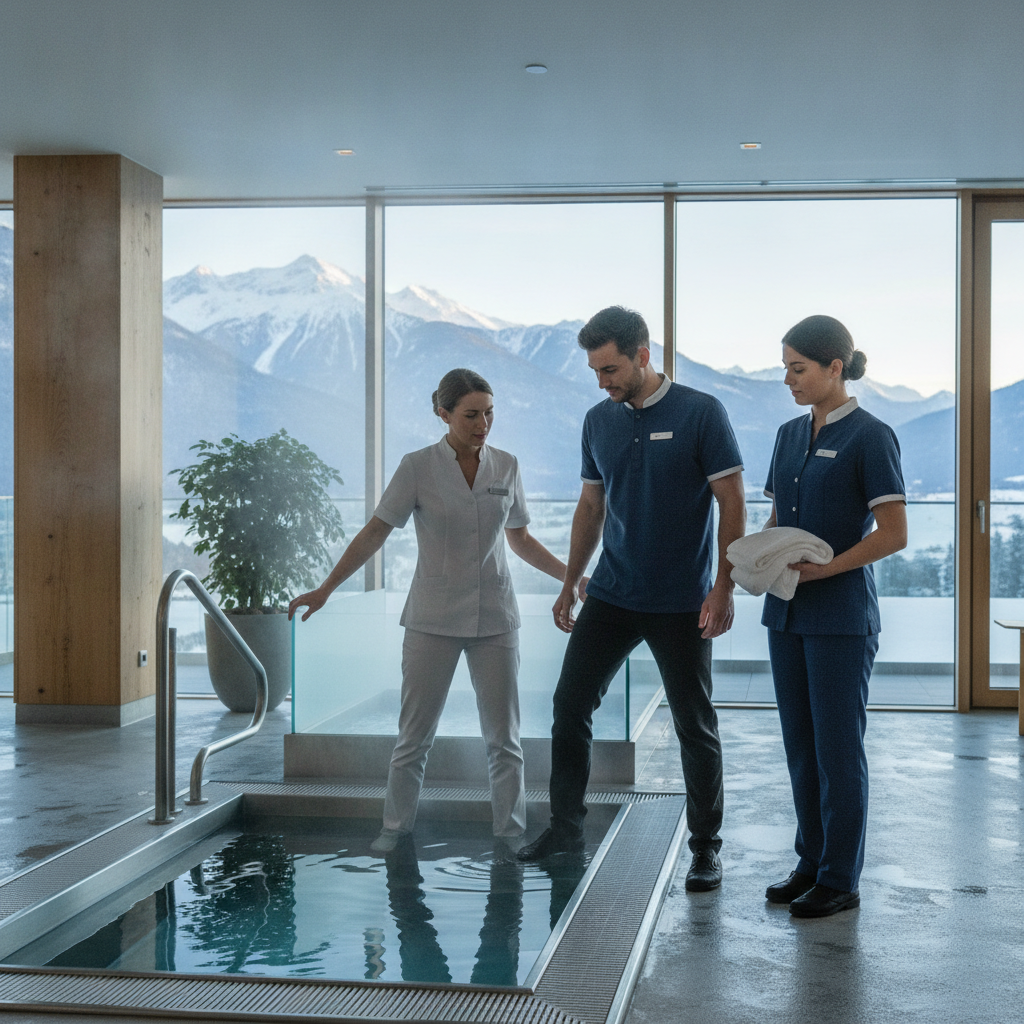
Employee training for hotel cold plunge operations is the single most important factor separating a safe, guest-loved wellness amenity from a liability waiting to happen. As more hotels add cold plunge experiences, whether in dedicated wellness suites, pool decks, or in-room systems, front-of-house, spa, and engineering staff need structured, documented instruction on screening guests, monitoring sessions, maintaining water quality, and responding to emergencies. This guide lays out exactly what a complete employee training for hotel cold plunge operations program should include, who needs it, how often it should be refreshed, and how to document it so your property stays compliant and your guests stay safe.
TL;DR, The Bottom Line
Employee training for hotel cold plunge operations should treat the amenity as a supervised aquatic-health program, not a passive spa feature. At minimum, every staff member assigned to a cold plunge needs training in guest screening, cold-exposure emergency recognition, equipment operation, water sanitation, and documentation, refreshed at least annually. Properties that skip structured training expose guests to real medical risk and themselves to significant liability, while a documented program builds guest trust and supports regulatory compliance.
Quick Facts
- Recommended training refresh cycle: At least annually, plus full onboarding for every new hire
- Core training domains: Guest screening, emergency response, equipment operation, water quality, documentation
- Hotel segment market size (2025): approximately $48.4 million, projected to reach $86.5 million by 2033
- Commercial share of total cold-plunge market (2025): approximately 61.8%
- Governing public-health framework: CDC Model Aquatic Health Code (MAHC)
Why Employee Training for Hotel Cold Plunge Operations Matters
Cold plunge amenities deliver real guest demand, but they also introduce a genuine physiological risk that most hotel staff have never been trained to manage. Cold shock response can trigger involuntary gasping, hyperventilation, and a sudden spike in blood pressure within seconds of immersion, reactions that can be dangerous for guests with undiagnosed cardiovascular conditions. This is precisely why employee training for hotel cold plunge operations has to be treated with the same seriousness as pool lifeguard certification or food-safety training, not bundled into a five-minute amenity walkthrough during onboarding.
Properties that underinvest in employee training for hotel cold plunge operations are taking on outsized legal and reputational exposure for what is often a relatively modest amenity investment. A single unsupervised incident, a guest who faints, panics, or experiences a cardiac event in a cold plunge, can trigger litigation, regulatory scrutiny, and lasting brand damage that far outweighs the amenity's revenue contribution. Industry data shows the hotel cold-plunge segment is growing quickly, with one market estimate placing the hospitality segment at roughly $48.4 million in 2025 and projecting growth to $86.5 million by 2033. Growth of that pace means more untrained staff will be interacting with cold-water amenities every year unless hotels build training into their operating standards now.
What a Complete Training Curriculum Covers
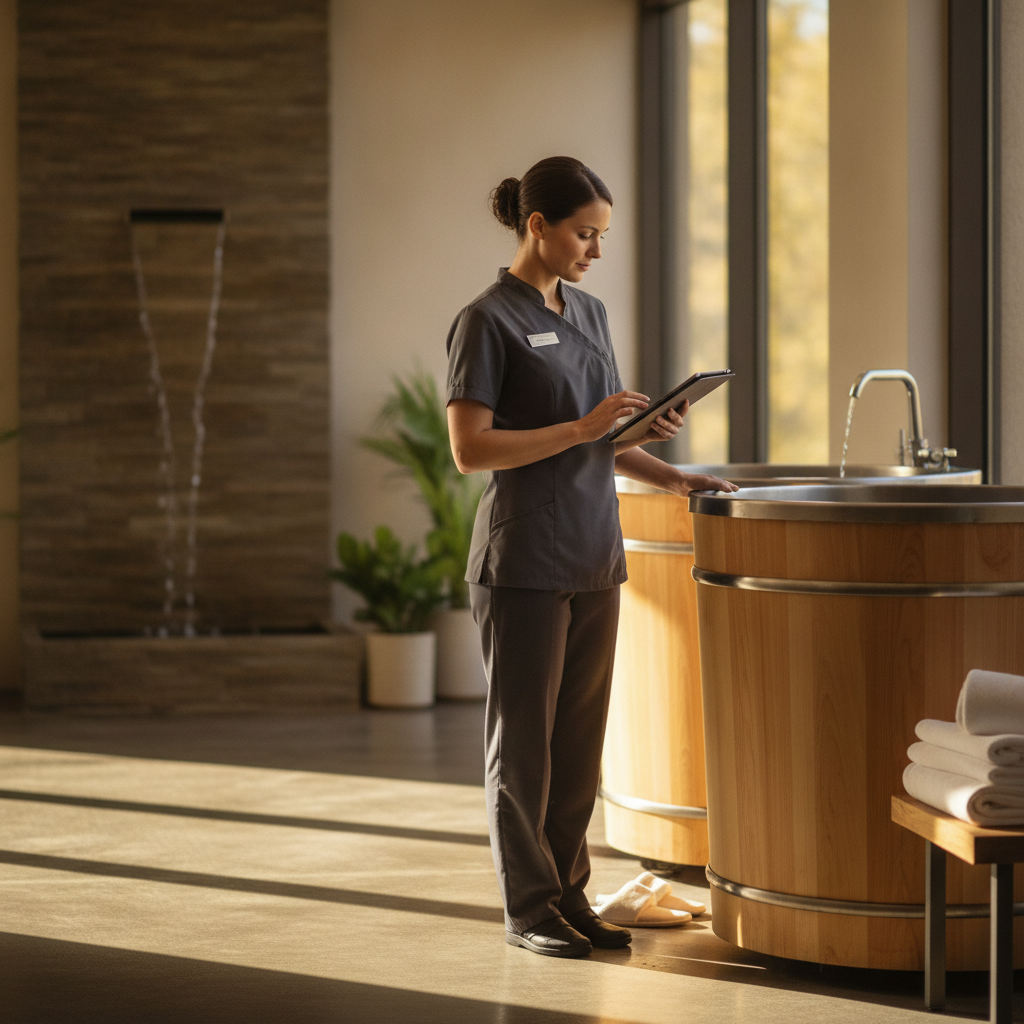
A complete employee training for hotel cold plunge operations curriculum rests on five pillars: guest screening and informed use, cold-exposure risk recognition, safe equipment operation, water quality and sanitation, and documentation. Skipping any one of these pillars leaves a gap that can turn a minor incident into a serious one. The table below summarizes who on your team needs each component and how often it should be refreshed.
| Training Domain | Primary Audience | Minimum Refresh |
|---|---|---|
| Guest screening & informed use | Spa attendants, pool staff, front desk, in-room concierge | Annually |
| Cold-exposure emergency response | All amenity-facing staff, duty managers | Annually, plus drills |
| Equipment operation & shutdown | Engineering, spa attendants | Onboarding, quarterly review |
| Water quality & sanitation | Engineering, housekeeping (for in-room units) | Monthly spot-check, annual certification |
| Documentation & compliance | Spa director, GM, risk management | Annual policy review |
Hotels that formalize this curriculum tend to treat the cold plunge the same way they treat a pool or fitness center: as a supervised amenity governed by written standard operating procedures, not an unmonitored bathroom fixture.
Anyone who can grant guest access, supervise a session, or respond to an emergency near a cold plunge, spa attendants, pool staff, engineering and maintenance, housekeeping for in-room units, and the manager on duty, should complete employee training for hotel cold plunge operations, not just the spa team.
Guest Screening and Informed Consent Protocols
This is the layer of employee training for hotel cold plunge operations most hotels underestimate. Staff need a clear, repeatable script for explaining the amenity's intended use, posted time limits, temperature range, and supervision rules before a guest ever enters the water. Training should prepare employees to:
- Explain session length, temperature, and prohibited behaviors in plain language.
- Ask about conditions that raise risk, including cardiovascular disease, uncontrolled hypertension, a history of fainting, pregnancy, cold sensitivity or Raynaud's phenomenon, neuropathy, serious respiratory conditions, intoxication, or recent illness.
- Direct guests with any flagged condition to consult a physician before use, and document that the conversation occurred.
- Decline access to guests who appear intoxicated, confused, or medically unstable, without exception, regardless of guest status or insistence.
- Require active supervision for any session where the property's risk assessment calls for it, rather than allowing unsupervised solo use.
Staff should never present cold immersion as a guaranteed medical treatment or attempt to diagnose a guest's condition. Claims about the amenity should stay limited to its documented purpose, recovery, relaxation, or wellness, without implying specific health outcomes.
Recognizing and Responding to Cold-Exposure Emergencies
No employee training for hotel cold plunge operations program is complete without teaching staff to tell the difference between expected discomfort and a genuine emergency. Mild shivering and gasping on entry are normal; the warning signs below are not, and staff should be trained to intervene immediately when they appear:
- Severe, uncontrolled shivering, confusion, slurred speech, or loss of coordination.
- Pale, blue, or numb skin, especially around the lips or fingertips.
- Hyperventilation, panic, chest pain, shortness of breath, fainting, or seizure.
- Sudden stillness or silence, which can indicate incapacitation rather than relaxation.
- Difficulty exiting the plunge or an inability to respond normally to questions.
Step-by-Step Emergency Response Protocol
- Direct immediate exit. Instruct the guest to leave the water at the first sign of distress; do not wait to see if symptoms pass.
- Assess responsiveness. Check for confusion, slurred speech, or inability to follow simple instructions.
- Begin passive rewarming. Use dry towels and warm (not hot) blankets; avoid hot showers or aggressive rewarming, which can cause complications.
- Call for medical help. Contact emergency services immediately for chest pain, breathing difficulty, confusion, or loss of consciousness.
- Document the incident. Record the time, symptoms, actions taken, and outcome in the facility's incident log.
Staff trained through employee training for hotel cold plunge operations should immediately instruct the guest to exit, assist if needed, begin passive rewarming with dry towels, monitor the guest closely, and call emergency medical services for any chest pain, confusion, breathing trouble, or loss of consciousness.
Cold shock can trigger a dangerous blood pressure spike within seconds of immersion, which is exactly why staff screening and supervision are the first line of defense in any hotel cold plunge program, not an afterthought layered on after launch.
Daily Operating, Maintenance, and Water Quality Procedures
Equipment competence is another non-negotiable pillar of employee training for hotel cold plunge operations. Staff assigned to the amenity, whether a shared spa unit or an in-room system, should be able to demonstrate, not just describe, the following before they are cleared to work unsupervised:
- Starting up and safely shutting down the chiller and filtration system.
- Verifying water temperature against the posted operating range before each shift or guest use.
- Checking circulation, filtration, pumps, alarms, covers, steps, and handholds for wear or malfunction.
- Restricting guest access immediately during maintenance, cleaning, or any unsafe condition.
- Logging sanitizer levels, pH, and water clarity according to the facility's written schedule.
- Preventing diving, horseplay, glass containers, and other unsafe behavior near the unit.
Properties using in-room or compact systems should not assume these units are exempt from water-quality training simply because they are smaller in scale than a traditional pool. Stagnant or poorly filtered water in any format can become a sanitation risk, so housekeeping and engineering staff responsible for in-room units need the same rigor applied to turnover cleaning and water changes that a dedicated spa team would apply to a shared plunge.
Documentation, Compliance, and Regulatory Requirements
Thorough employee training for hotel cold plunge operations also means teaching staff how to document every session, inspection, and incident in a way that would hold up under regulatory review. The CDC's Model Aquatic Health Code (MAHC) provides a widely referenced framework for public aquatic-facility design, operation, maintenance, and inspection, and the CDC has pointed to dedicated guidance covering cold-water venues specifically, including cold plunges and ice baths, addressing their design, construction, operation, maintenance, and inspection (Centers for Disease Control and Prevention).
Regulatory treatment of cold plunges varies significantly by jurisdiction. Depending on where your property operates, a cold plunge may fall under public-pool or spa rules, health-department codes, building and electrical requirements, plumbing codes, occupational-safety standards, or accessibility regulations. Training programs should include a module confirming which of these apply locally and assign responsibility for maintaining current permits and inspection records. Documentation that a well-run program should maintain includes:
- Signed training completion records for every staff member cleared to operate or supervise the amenity.
- Daily water-quality and equipment-check logs.
- Guest screening acknowledgment records, where required by the property's risk policy.
- Incident reports, including near-misses, with corrective actions noted.
- Annual policy review sign-off from the GM or spa director.
Requirements vary by jurisdiction, but many of the same local health-department and aquatic-facility rules that apply to pools and spas may extend to cold plunges. Hotels should confirm requirements with local authorities and build employee training for hotel cold plunge operations around whichever certifications or permits apply to their specific location.
Building an Ongoing Training and Certification Program
An effective employee training for hotel cold plunge operations program never ends at onboarding. Staff turnover, seasonal hiring, and evolving local codes all mean training has to be revisited on a set schedule rather than treated as a one-time orientation item. A practical structure includes:
- Onboarding certification for every new hire assigned to the amenity, completed before they work unsupervised.
- Annual refresher training covering screening protocols, emergency response, and any regulatory changes.
- Quarterly equipment competency checks for engineering and spa staff.
- Scheduled emergency drills, ideally unannounced, to test real response time and decision-making.
- A designated trainer or train-the-trainer model so knowledge does not depend on a single staff member.
Many hotels find it useful to pair internal training with resources and operational guidance from their equipment supplier. HotelPlunge works with hospitality teams to align in-room cold plunge deployment with the operational standards their staff need to run the amenity safely day to day, rather than treating the hardware and the training as separate problems. Building that relationship early, before launch, makes it far easier to keep employee training for hotel cold plunge operations current as your property adds rooms, suites, or additional units over time.
Frequently Asked Questions
What does employee training for hotel cold plunge operations typically include?
A complete program covers guest screening and informed consent, recognizing cold-exposure emergencies, safe equipment startup and shutdown, water quality and sanitation checks, and documentation practices that satisfy local health and safety requirements.
How often should employee training for hotel cold plunge operations be refreshed?
At minimum, staff should complete full training during onboarding and a refresher at least once a year, with quarterly equipment competency checks and periodic emergency drills for staff directly supervising the amenity.
Do housekeeping staff need cold plunge training for in-room units?
Yes. Any staff member responsible for cleaning, turning over, or maintaining water quality in an in-room cold plunge needs training in sanitation procedures and recognizing equipment issues, even though they may not be involved in active guest supervision.
What should staff never do or say to guests about the cold plunge?
Staff should never diagnose a guest's medical condition, promise specific health outcomes, or allow a guest with disclosed risk factors to use the amenity without directing them to seek medical advice first.
Who is ultimately responsible for cold plunge safety at a hotel?
While individual staff carry out day-to-day screening and supervision, the general manager and spa or wellness director are ultimately responsible for ensuring employee training for hotel cold plunge operations is current, documented, and aligned with local regulatory requirements.
Conclusion: Make Training the Foundation, Not an Afterthought
Cold plunge amenities are one of the fastest-growing additions to hotel wellness programs, but the equipment itself is only half the story. Investing in employee training for hotel cold plunge operations protects guests, protects staff, and protects your property's reputation in a market where a single mishandled incident can undo years of brand building. Treat the amenity the way you would any other supervised aquatic feature: with written protocols, scheduled refreshers, and documentation that can stand up to scrutiny.
If your property is evaluating or expanding in-room cold plunge amenities, HotelPlunge can help you pair the right equipment with an operational framework built for hospitality teams, not generic consumer use. Reach out to start building an employee training for hotel cold plunge operations plan that keeps your amenity safe, compliant, and guest-ready from day one.